Blog

How Garage Doors Improve Home Security

Beyond Convenience: How Modern Garage Doors Improve Home Security

In the landscape of residential security, the garage is often the most overlooked vulnerability. For many Chicago homeowners, the garage door serves as the primary entrance to the home, yet it is frequently the weakest point in the security envelope. According to national crime statistics, nearly 9% of residential break-ins occur through the garage, making it a prime target for opportunistic intruders.

At E.K. Garage Door, we view your garage door as more than just a motorized convenience; it is a critical defensive barrier. In 2026, the technology and materials used in garage door construction have evolved to offer a “digital and physical shield” that protects your family, your vehicles, and your peace of mind.

The Garage as a High-Value Target

Intruders target garages because they often house high-value, easily liquidable assets like power tools, bicycles, and vehicles. Perhaps more importantly, for homes with attached garages, once a burglar breaches the overhead door, they have a private, sheltered space to work on the interior door leading into your living quarters without being seen from the street.

Modern security strategies emphasize deterrence and delay. A flimsy, outdated garage door can be breached in seconds with basic tools. In contrast, a modern, professionally installed system forces an intruder to spend significant time and noise to attempt an entry,  factors that most criminals simply won’t risk.

Physical Reinforcement: The Strength of Modern Materials

A modern two-story home at night with a dark grey garage door featuring frosted vertical window panels on both sides, illuminated by warm sconce lighting and a full moon, with a family visible through a large front window.
 

The first line of defense is the physical integrity of the door panels. Older doors made of single-layer aluminum or thin wood are susceptible to “brute force” entry, where a panel can be kicked in or pried away from the track.

E.K. Garage Door recommends high-tensile steel or reinforced composite materials for maximum security.

  • Triple-Layer Construction: These doors feature a “sandwich” design with two layers of heavy-gauge steel surrounding a core of dense polyurethane insulation. This doesn’t just improve R-value; it creates a rigid, impact-resistant structure that is significantly harder to dent or penetrate.
  • Tamper-Resistant Hardware: We utilize heavy-duty struts and reinforced bottom brackets. These components prevent a common burglary tactic known as the “fishing” move, where an intruder uses a wire coat hanger to pull the emergency release cord from the outside.
  • Sturdy Guide Rails: Modern tracks are designed to be “interlocking,” ensuring that even if force is applied, the rollers cannot be easily popped out of the channel.

For technical guidance on the structural standards required to resist forced entry, homeowners can refer to the International Code Council (ICC), which sets the benchmark for residential safety and building integrity.

Smart Technology: Digital Vigilance 24/7

The most significant evolution in garage security over the last decade is the integration of Smart Home Technology. In 2026, your garage door is no longer a “dumb” appliance; it is a connected security hub.

Rolling Code Encryption

Older garage door openers used “static” codes that could be easily intercepted by “code grabber” devices. Modern systems installed by E.K. Garage Door utilizes Rolling Code Technology. Every time you press your remote, a new, encrypted code is generated from billions of possibilities. The previous code is immediately discarded, making it virtually impossible for a hacker to replicate the signal.

Real-Time Monitoring and Geofencing

With smartphone integration, you are never “away” from your garage.

  • Instant Alerts: Receive a notification the moment your door is opened or closed. This is vital for detecting unauthorized access while you are at work or on vacation.
  • Auto-Close Timers: One of the most common security lapses is simply forgetting to close the door. Smart openers allow you to set a schedule or a timer that ensures the door closes automatically after a set period of activity.
  • Geofencing: Your door can be programmed to detect your vehicle’s GPS proximity, opening as you arrive and, more importantly locking securely as soon as you depart the “home zone.”

The National Institute of Standards and Technology (NIST) provides extensive resources on the encryption standards that protect these IoT devices from digital intrusion, ensuring your “smart” home remains a “safe” home.

Integrated Surveillance and Lighting

A well-lit property is a major deterrent. Intruders prefer to work under the cover of darkness. Modern openers often come equipped with 360-degree LED lighting and built-in 4K HD cameras. These cameras feature two-way audio and motion-activated recording, allowing you to see and speak to anyone near your garage threshold directly from your phone.

According to home security tips from Security.org, combining motion-activated lighting with visible surveillance cameras can reduce the likelihood of a targeted break-in by over 50%. These systems act as a psychological barrier, signaling to potential intruders that your home is actively monitored.

Internal Defense: Securing the Connection

While the overhead door is the primary barrier, the door leading from the garage to your home is often the final line of defense. We advocate for a “layered” security approach.

  • Solid-Core Interior Doors: The interior door should be as strong as your front door, ideally solid hardwood or metal-clad.
  • Deadbolt Integration: Always install a high-quality deadbolt on the interior door.
  • Smart Sensors: Adding a simple contact sensor to this interior door ensures that even if the garage is breached, your home’s main alarm system will trigger immediately.

Resources from Iowa State University Extension emphasize that treating the garage as an “exterior zone” rather than an “interior room” is essential for a comprehensive home safety posture.

Maintenance as a Security Measure

A poorly maintained door is a security risk. If your door doesn’t close flush with the ground, it leaves a gap that can be exploited. If the springs are weak, the door may not stay locked under the tension of the motor. Regular preventative maintenance ensures that all locking mechanisms engage correctly and that safety sensors are aligned to prevent “phantom” openings.

Upgrade Your Chicago Home’s Defense Today

In an era where home security is a top priority for Chicago families, your garage door should be your strongest asset, not your weakest link. Whether you need a high-impact reinforced steel door, a smart opener with biometric encryption, or a professional security audit of your current system, E.K. Garage Door is here to help. We combine local Chicago expertise with the latest in global security technology to provide a seamless, fortress-like entry for your home. Don’t wait for a security breach to realize your door is outdated. Contact us today at (312) 860-1171 to schedule a professional inspection and take the first step in fortifying your home.

Understanding Garage Door Springs

A Comprehensive Guide to Understanding Garage Door Springs

For many Chicago homeowners, the garage door is the most used entry point to the home. We press a button, and the door glides upward effortlessly. However, that “effortless” movement isn’t powered by the motor alone; the real heavy lifting is done by the garage door springs. These high-tension components counterbalance the hundreds of pounds of steel and insulation, making the door light enough to be moved by a small motor or a human hand. At E.K. Garage Door, we believe that understanding the mechanics and safety risks of your springs is essential for every homeowner.

The Engineering of Counterbalance: How Springs Work

A standard residential garage door can weigh anywhere from 150 to over 400 pounds. Without a counterbalancing system, opening such a door would require immense physical strength and would likely burn out a standard opener motor in a single use. Garage door springs solve this by storing energy when the door is closed.

When the door is in the “down” position, the springs are under maximum tension, either stretched out or wound tightly. As you initiate the opening cycle, this stored potential energy is released, providing the torque or pull necessary to neutralize the door’s weight. According to engineering principles detailed by the University of Nebraska-Lincoln, the spring acts as a mechanical battery, discharging its energy to assist the lift and recharging as gravity pulls the door back down to the floor.

Torsion vs. Extension Springs: What’s in Your Garage?

Most Chicago residences utilize one of two primary spring systems. Identifying which one you have is the first step in proper maintenance.

Torsion Springs: The Modern Standard

Torsion springs are the large, tightly wound coils located on a metal shaft directly above the garage door opening. They operate by twisting (torsion) rather than stretching. When the door closes, cables attached to the bottom corners pull on drums, which in turn wind the springs.

  • Longevity: Torsion springs typically last 10,000 to 20,000 cycles.
  • Safety: Because they are mounted on a shaft, if they snap, they generally stay on the bar rather than flying across the garage.
  • Smoothness: They provide a more balanced, steady motion, which is ideal for heavy, insulated doors.

Extension Springs: The Legacy Choice

Commonly found in older Chicago bungalows or garages with low headroom, extension springs run horizontally along the upper tracks on both sides of the door. They operate by physically stretching out as the door closes.

  • Cost: These are often less expensive to install initially.
  • Risk Factor: Because they are not secured on a shaft, they require safety cables to prevent them from becoming dangerous projectiles if they snap under tension.
  • Wear Pattern: They often wear unevenly, which can cause the door to become “jerky” or lopsided over time.

Why Garage Door Springs Are Inherently Dangerous

The tension required to lift a 300-pound door is immense. If a spring fails, that energy is released instantly and violently. This is why the U.S. Consumer Product Safety Commission (CPSC) classifies garage door springs as high-risk components. A snapping spring can shatter windows, dent car hoods, or cause life-threatening injuries to anyone standing nearby.

Beyond the risk of a sudden break, the act of adjusting or replacing these springs is where most DIY accidents occur. Torsion springs require specialized winding bars and precise torque calculations. One slip of a wrench can result in the high-speed unwinding of the steel coil, which can easily break bones or cause severe lacerations. At E.K. Garage Door, we strongly advise homeowners to stick to visual inspections and leave the mechanical work to certified technicians.

Identifying the Warning Signs of Spring Fatigue

Springs do not last forever. Most are rated for a specific number of “cycles” (one opening and one closing). For a family that uses the garage four times a day, a 10,000-cycle spring will likely reach its elastic limit in about 6 to 7 years.

Watch for these red flags in your garage:

  • The “Loud Bang”: If you hear a thunderous noise from the garage while no one is there, it is likely a torsion spring snapping.
  • Visible Gaps: A broken torsion spring will show a clear separation of two or more inches between the coils.
  • The Heavy Door Test: If your opener struggles to lift the door or if the door feels impossible to lift manually, the springs have likely lost their tension.
  • Lopsided Movement: If one side of the door hangs lower than the other, an extension spring on one side has likely failed or stretched.
  • Slow Response: If the door starts to open but stops after a few inches, the opener’s safety sensors are detecting that the “dead weight” is too heavy to lift safely.

Extending the Life of Your Springs

While you shouldn’t adjust springs yourself, you can significantly extend their lifespan with basic care. Chicago’s humidity and road salt are the primary enemies of spring steel, leading to rust that creates “friction points” within the coils.

We recommend applying a high-quality silicone-based lubricant to the springs every three to six months. This prevents rust and allows the coils to slide against each other smoothly, reducing the internal heat and friction that leads to metal fatigue. Additionally, keeping your garage well-ventilated and your bottom weatherstripping intact can reduce the moisture levels that accelerate corrosion. For more technical guidance on residential mechanical standards, the International Code Council (ICC) provides extensive benchmarks for property maintenance.

Professional Care for Chicago Homeowners

A young male technician in blue coveralls stands on a stepladder to inspect the upper tracks of an open garage door while a homeowner watches.
 

At E.K. Garage Door, we specialize in the high-precision world of garage door spring replacement and calibration. We understand that a broken spring isn’t just a mechanical failure; it’s a disruption that can trap your car in the garage or leave your home vulnerable. Our technicians carry a wide variety of high-cycle springs on our trucks, ensuring that we can provide a safe, “one-trip” solution to get your door back in balance. We perform a full safety inspection with every spring service, checking your cables, drums, and bearings to ensure the entire system is working in harmony. Don’t risk your safety or the integrity of your home on a DIY spring repair. Call us today at (312) 860-1171 to schedule a professional balance test and inspection.

Garage Door Inspections: What to Expect

For most Chicago homeowners, the garage door is the “giant” of the household, the largest moving object and the most frequent point of entry. Yet, it often remains out of mind until it stops mid-cycle or emits a bone-chilling screech. A professional garage door inspection is not just a cursory look at the panels; it is a technical audit of a complex mechanical system under extreme tension. At E.K. Garage Door, our inspection process is designed to identify “silent” wear before it translates into an expensive midnight emergency. Knowing what to expect during this process can help you understand the value of proactive maintenance and ensure your home remains both functional and secure.

The Initial Visual and Structural Assessment

The inspection begins with a comprehensive visual sweep. Our technicians look for the subtle cues of structural fatigue that often go unnoticed by the untrained eye. In Chicago’s fluctuating climate, weather-induced wear is a primary focus. We examine the door panels for signs of “oil-canning” or warping, which can indicate that the door is under excessive stress or that the internal insulation is failing.

We also pay close attention to the tracks and hardware. The vertical and horizontal tracks must be perfectly plumb and level. Over time, the vibration of the door can loosen the lag bolts that secure the tracks to your garage walls. A professional inspector will check every bracket, hinge, and bolt, tightening them to factory specifications to ensure the door’s “skeleton” is rigid and reliable.

Testing the Mechanical Core: Springs and Cables

A female technician in a dark blue uniform and safety glasses stands inside an open garage, holding a flashlight and a clipboard while looking toward the door track.

The most dangerous and critical part of your garage door system is the torsion or extension spring. These components are responsible for the heavy lifting, and they operate under enough torque to cause serious injury if they snap. During an inspection, we don’t just look for rust; we measure the spring’s wire diameter and check for “gapping” in the coils, which indicates that the metal is reaching its elastic limit.

Similarly, we inspect the lifting cables for fraying or “bird-nesting.” Even a single broken strand in a cable can lead to a lopsided door, which then puts a lethal amount of pressure on the remaining cable. According to safety data from the U.S. Consumer Product Safety Commission (CPSC), failing to address worn springs and cables is a leading cause of catastrophic door collapses.

The Balance and Force Calibration

A common misconception is that the garage door opener does all the lifting. In a healthy system, the opener should only provide the “guidance,” while the springs do the work. To test this, our technicians perform a manual balance test. By disconnecting the opener and lifting the door halfway, we can determine if the springs are properly tensioned. If the door slams shut or flies upward, the system is out of balance, which will eventually burn out your motor.

Furthermore, we calibrate the force settings of your opener. As grease thickens in the Chicago winter, an opener might require more force to move. However, if the force is set too high, the door may not stop if it hits an obstruction. We ensure the motor is set to the minimum amount of power required for smooth operation, protecting both the motor’s lifespan and your family’s safety.

Rigorous Safety Feature Verification (UL 325 Standards)

Safety is the heartbeat of every E.K. Garage Door inspection. We follow the strict guidelines outlined in UL 325, the federal standard for door and gate operators. This phase of the inspection is non-negotiable and includes two primary tests:

  • The Photo-Eye Alignment Test: We ensure the infrared sensors are mounted no higher than 6 inches from the floor (per NIST digital security and safety standards) and are perfectly aligned. We test their response by obstructing the beam during a closing cycle to ensure the door reverses instantly.
  • The Mechanical Reversal Test: By placing a solid object, such as a 2×4, in the door’s path, we verify that the internal “brain” of the opener detects the resistance and pulls the door back up within seconds.

If a door fails either of these tests, it is considered a safety hazard. Our inspectors will provide immediate recommendations to bring the system back into compliance with local building codes and International Code Council (ICC) standards.

Lubrication and Performance Tuning

The final stage of a professional inspection is the “tune-up.” We apply high-performance, silicone or lithium-based lubricants to all moving parts, including the rollers, hinges, and springs. Unlike standard grease, these specialized lubricants are designed to withstand Chicago’s sub-zero temperatures without becoming tacky or attracting abrasive grit.

We also evaluate the rollers. If your system still utilizes old-fashioned steel rollers, they may be contributing to excessive noise and vibration. We often recommend a switch to nylon-coated rollers with ball bearings, which offer a significantly quieter operation and a longer lifespan. This performance tuning doesn’t just make the door run better, it reduces the decibel level of your garage, which is a major benefit for homes with bedrooms located above the garage.

Why Chicago Homeowners Choose E.K. Garage Door

A garage door inspection is an investment in your home’s security and your family’s peace of mind. By identifying minor issues like a frayed cable or a loose bracket today, you avoid the high costs and stress of an emergency repair tomorrow. At E.K. Garage Door, our technicians bring years of local experience and technical expertise to every driveway. We don’t just “check boxes”; we provide a detailed report and a clear path forward to keep your door running like new through every Chicago season.

Schedule Your 25-Point Safety Inspection Today

Don’t wait for your garage door to become a liability or a loud nuisance. A professional inspection from E.K. Garage Door ensures that every spring, cable, and sensor is operating at peak performance, protecting your property and providing the reliability you deserve. Whether you are preparing for a brutal winter or simply want to ensure your home’s largest entrance is secure, our team is ready to provide a thorough, expert assessment. Contact us to schedule your professional inspection. Let us give you the confidence that your garage door will work every time, without fail.

Garage Door Technology: What’s New?

The humble garage door has undergone a radical transformation. No longer just a heavy slab of steel or wood, the modern garage door is now a sophisticated, high-tech gateway that serves as the “brain” of home security and energy management. For Chicago homeowners, where extreme weather and urban security are constant considerations, these technological leaps offer more than just convenience, they provide a comprehensive digital shield. At E.K. Garage Door, we stay at the cutting edge of these innovations to ensure our clients benefit from the latest in safety, efficiency, and smart integration.

The Rise of AI-Driven Predictive Maintenance

One of the most significant breakthroughs in 2026 is the integration of Artificial Intelligence (AI) into garage door openers. Traditional systems were reactive, you called for help only after a spring snapped or the motor seized. Modern AI-enhanced systems are proactive. They utilize vibration sensors and usage-cycle tracking to analyze the “health” of your door in real-time.

These systems can detect minute changes in the sound of your motor or a slight increase in the force required to lift the door. When an anomaly is detected, the system sends a predictive alert to your smartphone, warning you that a component is nearing failure before it actually breaks. Research from Stanford University on IoT (Internet of Things) demonstrates that predictive diagnostics can extend the lifespan of residential mechanical systems by up to 30%, saving homeowners thousands in emergency replacement costs.

Biometric Security: Moving Beyond the Keypad

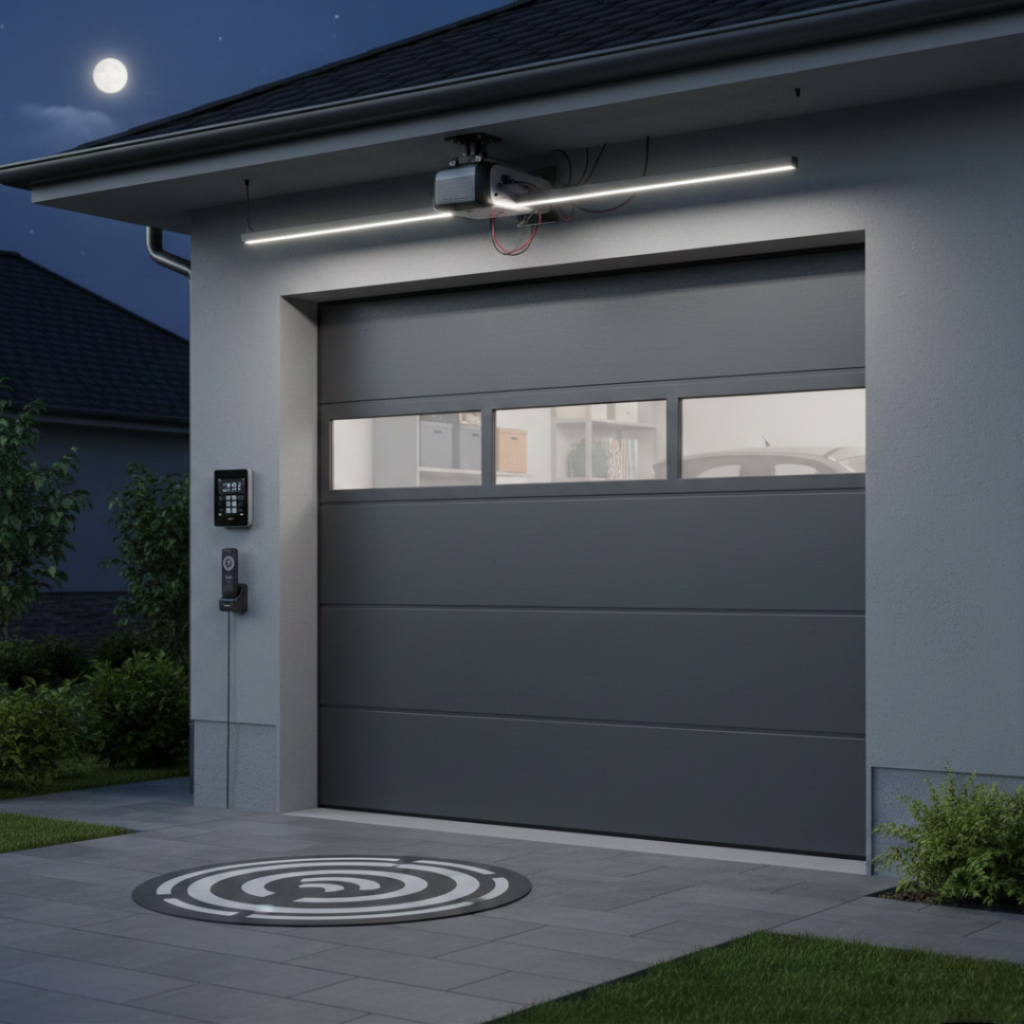
A sleek, dark grey sectional garage door at night featuring a long horizontal LED light bar above the opening, a wall-mounted digital control panel, and a circular target-style landing pad on the driveway under a full moon.
 

The days of hiding a spare key under a flowerpot or worrying about a stolen remote are over. 2026 has seen the mainstream adoption of biometric access for garage doors. High-end openers now feature integrated fingerprint scanners or facial recognition cameras directly on the exterior trim.

Why Biometrics Are Changing the Game:

  • Uncopyable Access: Unlike rolling codes, which are highly secure but technically interceptable, biometric data is nearly impossible for intruders to spoof.
  • Temporary “Guest” Permissions: You can program your system to recognize the faces of delivery drivers or service professionals for a specific window of time, revoking access automatically once the job is done.
  • Enhanced Child Safety: Parents receive notifications exactly when their children arrive home, verified by facial recognition, providing an extra layer of peace of mind.

According to home security benchmarks provided by the National Institute of Standards and Technology (NIST), biometric multi-factor authentication is currently the gold standard for preventing unauthorized residential entry.

Sustainability and “Smart” Thermal Management

In Chicago, energy efficiency isn’t just a buzzword; it’s a financial necessity. The latest garage door technology focuses on active thermal management. Modern doors now feature advanced polyurethane cores with R-values exceeding 18.0, but the real innovation lies in the “Smart Seal” technology.

New systems utilize sensors to monitor the air quality and temperature inside the garage. If the system detects rising humidity that could lead to mold or extreme temperature drops that might threaten your vehicle’s battery, it can trigger smart ventilation or adjust its seal pressure to optimize the garage’s climate. Furthermore, many 2026 models are designed for solar-ready integration, allowing the opener to run entirely on renewable energy stored in a dedicated battery backup, a crucial feature during Chicago’s frequent summer storm power outages.

Seamless Smart Home Ecosystem Integration

In 2026, the garage door is no longer a siloed appliance; it is a central node in your Smart Home Ecosystem. Compatibility with platforms like Apple HomeKit, Amazon Alexa, and Google Home is now standard, but the level of integration has deepened.

Advanced Integration Features Include:

  • Geofencing 2.0: Utilizing your car’s GPS or your smartphone’s proximity, the door anticipates your arrival. As you turn onto your street, the door opens, and your home’s interior lights turn on simultaneously.
  • In-Garage Delivery Synergy: Technology like Amazon Key has evolved. Sensors now create a “secure zone” within your garage where couriers can leave packages, monitored by a 360-degree 4K camera integrated into the opener itself.
  • Vehicle Health Monitoring: Some high-tech openers can now sync with your vehicle’s onboard computer via Bluetooth, alerting you if your car is leaking fluid or if your tire pressure is low while you are parked.

For more information on the evolving standards of smart home connectivity, homeowners can consult the International Code Council (ICC), which provides the regulatory framework for safe and secure automated building systems.

Experience the Future of Access with E.K. Garage Door

The technology behind your garage door is moving faster than ever, and choosing the right system requires an expert who understands both mechanical engineering and digital security. At E.K. Garage Door, we don’t just install doors; we design modern access solutions tailored to the unique needs of Chicago families. Whether you are looking for the whisper-quiet operation of a direct-drive AI motor or the ironclad security of biometric access, our team has the expertise to bring your home into the future. Don’t settle for a 20th-century door in a 21st-century world. Contact us today to schedule a consultation and discover how the latest innovations can make your home safer, smarter, and more efficient.