Blog

Why Garage Door Springs Matter and What Every Chicago Homeowner Needs to Know

In the world of home maintenance, few components are as vital, and as misunderstood, as the garage door spring. Many homeowners in Chicago mistakenly believe that the electric opener does the heavy lifting when the door moves. In reality, the opener is merely the “brain” that initiates movement; the garage door springs are the “muscles” that do 95% of the work. At EK Garage Door, we have spent years educating our clients on the physics and safety risks associated with these high-tension components. Understanding how they work, why they fail, and how to spot trouble can save you from costly emergency repairs and, more importantly, prevent life-threatening accidents.

The Physics of the Lift: Torsion vs. Extension Springs

To understand why springs matter, you must first understand the sheer weight they are managing. A standard double-car garage door can weigh anywhere from 150 to over 300 pounds. Springs work by storing mechanical energy, either through twisting (torsion) or stretching (extension), to create a counterbalance.

Torsion Springs

Most modern Chicago homes utilize torsion springs. These are mounted on a metal shaft directly above the door opening. As the door closes, the cables attached to the bottom corners pull on the drums, winding the springs and storing energy. When you open the door, that stored energy unwinds, helping the door lift with minimal effort. Because they distribute weight more evenly, torsion springs are generally considered safer and longer-lasting.

Extension Springs

Common in older homes or garages with low headroom, extension springs run parallel to the horizontal tracks. They stretch out as the door closes and contract to pull the door up. Because they act independently on each side, they are more prone to causing the door to “jerk” or become unbalanced if one wears out faster than the other. According to the Consumer Product Safety Commission (CPSC), extension springs should always be installed with a safety cable to prevent them from becoming dangerous projectiles if they snap.


Why Chicago Winters Are the Enemy of Your Springs

Living in the Midwest presents unique challenges for garage door hardware. Steel is highly susceptible to temperature fluctuations. In the sub-zero temperatures of a Chicago winter, metal becomes brittle. When you combine cold-induced brittleness with the fact that metal contracts in the cold, you have a recipe for disaster.

Most garage door springs snap during the first major cold snap of the year. The spring is already under immense tension; when the cold causes the metal to tighten further, the internal stress exceeds the material’s threshold, resulting in a loud “bang” that many homeowners mistake for a gunshot. Regular lubrication with a low-temperature silicone spray is essential to reduce the friction that accelerates this cold-weather fatigue.

The “Cycle Life” Reality: Every Spring Has an Expiration Date
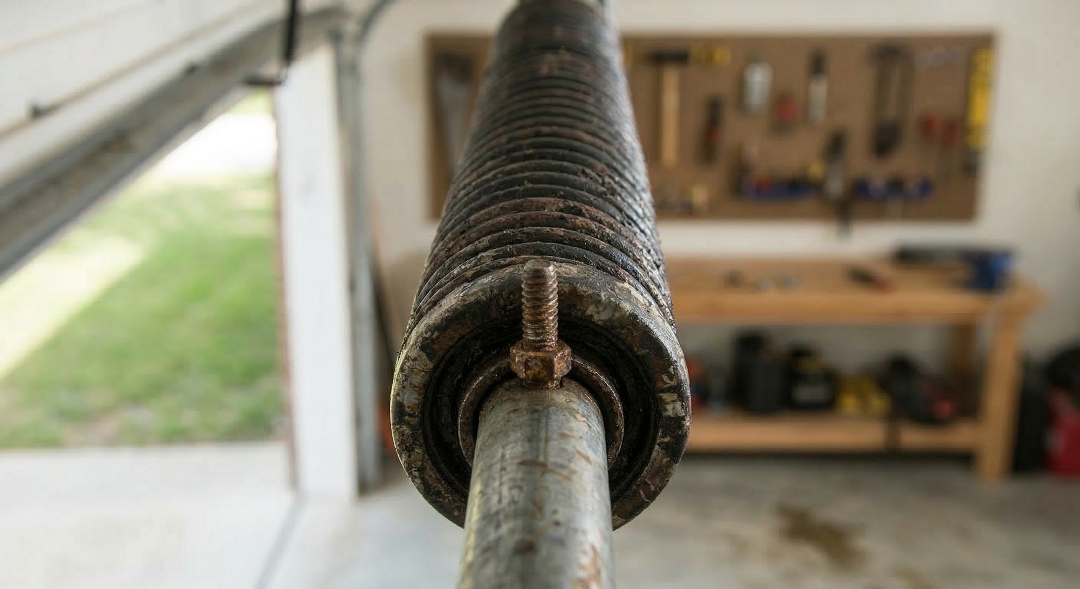
A first-person perspective looking down the length of a metal garage door torsion spring mounted on a steel shaft. The foreground shows a rusted set screw and bolt, while the background depicts a blurred garage workshop with a wooden workbench and pegboard.

Garage door springs are not designed to last forever. They are rated by “cycles,” where one cycle represents the door opening and closing once. A standard builder-grade spring is typically rated for 10,000 cycles.

If you use your garage door four times a day (commuting to work, running errands, and coming home), you are looking at roughly 1,460 cycles per year. This means your springs have an expected lifespan of approximately 7 to 9 years. However, factors like rust, lack of lubrication, and the extreme Chicago humidity can shorten this lifespan significantly. At EK Garage Door, we often recommend upgrading to “High-Cycle” springs (rated for 25,000+ cycles) for busy households to ensure long-term reliability.

Signs of a Failing or Broken Spring

Identifying a problem before the spring snaps is the best way to avoid being “held hostage” by a car trapped in the garage. A broken spring is a primary cause of garage door opener failure, as the motor tries to lift the full dead weight of the door without the spring’s help, often stripping the gears in the process.

Keep an eye out for these red flags:

  1. A Visible Gap: If you look at the spring above your door and see a 2-inch gap between the coils, the spring has already snapped.
  2. The Door Stops After 6 Inches: Most openers have a safety sensor that detects excessive weight. If the door starts to rise and then stops immediately, it’s likely because it no longer has the spring’s assistance.
  3. Heavy Manual Operation: If you pull the emergency release cord and cannot easily lift the door with one hand, your springs are either unbalanced or near the end of their life.
  4. Loud Squeaking or Grinding: This is often the sound of metal-on-metal friction or the spring “binding” against itself.

The Danger of DIY: Why You Should Never Tighten Springs Yourself

While many home repairs are suitable for a weekend DIY project, garage door spring adjustment is not one of them. The tension held within a torsion spring is enough to cause severe lacerations, bone fractures, or even fatalities if the spring or the winding bar slips.

Professional technicians use specialized winding bars and heavy-duty vice grips to manage the torque. Furthermore, springs must be matched exactly to the weight and height of the door. Installing a spring that is “close enough” in size can lead to an unbalanced door that either crashes down or flies up uncontrollably. Data from DASMA (Door & Access Systems Manufacturers Association) highlights that thousands of injuries occur annually due to improper handling of high-tension garage hardware.

Enhancing Longevity Through Professional Maintenance

The best way to protect your investment is through a biannual “Tune-Up.” During a professional visit from EK Garage Door, we don’t just look at the springs. We check the balance of the door, which ensures the springs are under the correct amount of tension. We also inspect the cables and pulleys. When a spring breaks, the cables often lose tension and can become tangled or frayed. By maintaining the entire system, you ensure that the load is distributed evenly, preventing one part from failing prematurely.

Partner with Chicago’s Trusted Spring Specialists

A broken garage door spring isn’t just a nuisance; it’s a significant safety hazard and a disruption to your daily life. At EK Garage Door, we understand the urgency of these situations, especially when your vehicle is stuck inside. Our team of certified technicians specializes in the precision replacement and calibration of both torsion and extension springs, using only high-quality, oil-tempered steel components designed to withstand the harsh Illinois climate. We take pride in our “Safety First” approach, ensuring that every door we service is perfectly balanced and compliant with UL 325 safety standards. If you’ve heard a loud snap, noticed your door is moving slowly, or realized it has been over seven years since your last service, contact us today at (312) 860-1171 to schedule an expert inspection,let us handle the heavy lifting so you don’t have to.
What Happens During a Garage Door Inspection?

For most homeowners in Chicago, the garage door is a “set it and forget it” feature, until it refuses to open on a sub-zero morning. Because it is the largest moving object in your home, its complexity is often underestimated. A professional garage door inspection is a high-level diagnostic process designed to identify microscopic fractures in springs, misalignments in tracks, and electronic glitches in the opener before they manifest as dangerous failures.

At EK Garage Door, we treat an inspection as a preventative surgery for your home’s exterior. Following the safety standards set by the Door and Access Systems Manufacturers Association (DASMA), our comprehensive evaluation ensures every component is performing within its mechanical limits. Here is exactly what our experts look for when they step into your garage.

1. Visual and Structural Integrity Audit

The inspection begins with a “macro” view of the entire system. We examine the garage door panels for signs of stress, particularly at the points where the hardware is bolted to the sections. In Chicago’s humid summers and salty winters, metal doors can develop oxidation (rust) at the bottom, while wooden doors may show signs of delamination or rot.

We also scrutinize the tracks. Over time, the vibration of the door can cause track bolts to loosen, leading to a “wobbly” path. We use precision levels to ensure the vertical tracks are plumb and the horizontal tracks are properly pitched. Even a 1/4-inch misalignment can put undue torque on the rollers, leading to a premature breakdown of the entire assembly.

2. The High-Tension Component Analysis

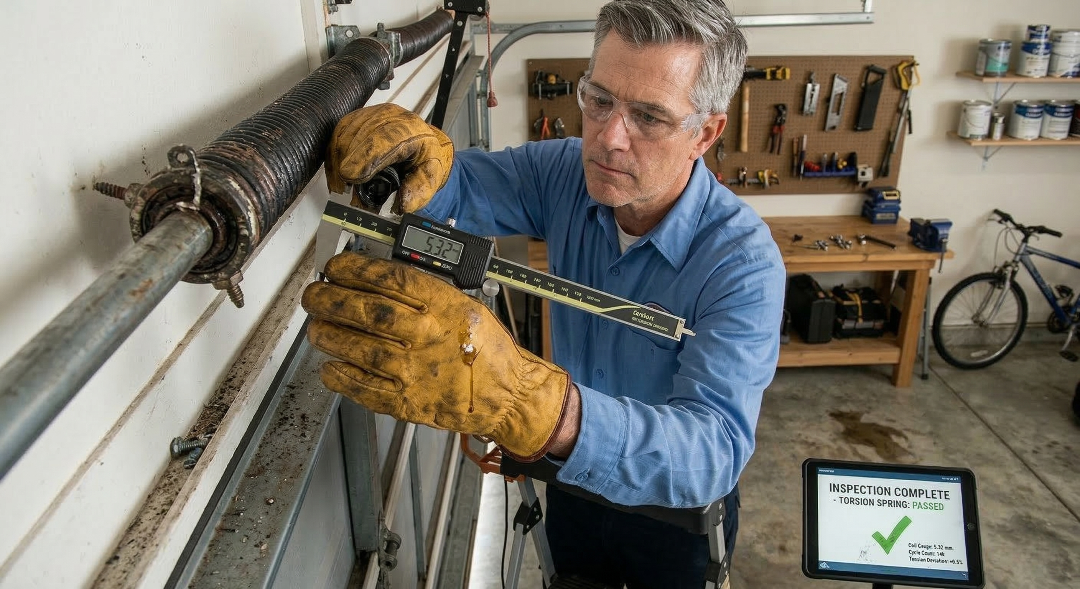
A male garage door technician in a blue shirt and safety glasses uses a digital caliper to measure the diameter of a large metal torsion spring.
 

This is the most critical part of the inspection. Garage doors rely on a system of springs and cables to offset their massive weight. Whether you have torsion springs (mounted above the door) or extension springs (mounted along the tracks), these components are under thousands of pounds of tension.

  • Spring Fatigue: We look for “gapping” in the coils or visible rust, which indicates the metal is becoming brittle.
  • Cable Fraying: We inspect the steel cables for “bird-caging” or broken strands. According to the Consumer Product Safety Commission (CPSC), a snapped cable can cause a door to crash down with enough force to crush a vehicle or cause fatal injury.
  • Hardware Tightening: We check the “drums” where the cables wind and the center bearing plates. If these bearings are dry or worn, they create friction that mimics the sound of a dying motor.

3. Dynamic Balance and Force Testing

A perfectly functioning garage door should be “weightless.” During the inspection, our technicians disconnect the automatic opener and operate the door manually. This is the Balance Test. If the door is properly balanced, it should stay in place when lifted halfway up. If it slams shut or shoots upward, the spring tension is incorrect.

We also test the Opener Force Settings. Modern openers have a “brain” that monitors how much work the motor is doing. If the door is too heavy due to poor balance, the motor will overheat. We recalibrate these settings to ensure the motor is only using the minimum force necessary, which significantly extends the lifespan of the gear kit and drive belt.

4. Safety Protocol: The 2×4 and Photo-Eye Test

Safety is mandated by federal law under UL 325 standards. We perform a series of tests to ensure your door is compliant with modern safety requirements:

  • The Reversal Test: We place a solid object (like a 2×4 piece of wood) on the garage floor. When the door hits the object, it must reverse instantly.
  • Photo-Eye Calibration: We verify that the infrared sensors are mounted no higher than 6 inches above the floor. We check the alignment and wiring to ensure that if a child or pet breaks the beam, the door stops immediately.
  • Entrapment Protection: We ensure all wall-mounted push buttons are at least 5 feet high, out of the reach of small children, as recommended by the National Institute of Standards and Technology (NIST).

5. Lubrication and Environmental Sealing

The final phase of a professional inspection is the “tune” portion of the “tune-up.” We apply professional-grade silicone or lithium-based lubricants to all pivot points, hinges, and roller stems. We specifically avoid heavy greases, which trap Chicago road salt and dirt, creating an abrasive paste that grinds down your hardware.

Finally, we inspect the weatherstripping. A cracked bottom seal or a missing side gasket allows the “chimney effect” to pull freezing air into your home, skyrocketing your energy bills. We check for light peeking through the edges of the door, ensuring your garage remains a sealed thermal buffer against the Illinois climate.

Why Professional Expertise Matters in Chicago

While some homeowners attempt a visual check themselves, many of the most dangerous garage door issues are invisible to the untrained eye. A microscopic crack in a winding cone or a slightly frayed cable inside a drum can be the precursor to a catastrophic failure. Professional technicians at EK Garage Door possess the specialized tools, such as tension meters and infrared thermometers, to catch these issues before they become emergency repairs. In a city where the weather is a constant adversary, a documented inspection history also helps maintain your manufacturer’s warranty and can even lower your home insurance premiums by demonstrating a commitment to safety and security.

Schedule Your 29-Point Safety Inspection Today

Don’t wait for a snapped spring to leave your car trapped inside or your home vulnerable to the elements. A professional inspection is a small investment that provides massive returns in safety, energy efficiency, and peace of mind. At EK Garage Door, our Chicago-based specialists provide a detailed report of your door’s health, along with transparent recommendations to keep your system running silently and reliably for years to come. Contact us today at (312) 860-1171 to book your comprehensive inspection, ensuring your home’s largest moving part is as safe as it is functional.

The Importance of Garage Door Weatherstripping for Energy Efficiency

In a city like Chicago, where the wind chill can drop temperatures to sub-zero levels in a matter of hours, homeowners are well-versed in the importance of insulation. We upgrade our attics, invest in triple-pane windows, and seal our front doors. Yet, the largest “opening” in the home, the garage door, is often left with gaps that act as a thermal vacuum. At EK Garage Door, we have seen that even the most expensive insulated garage door is only as effective as its seals. Professional weatherstripping is the critical finishing touch that transforms a garage from a drafty storage space into a true thermal barrier, protecting both your comfort and your wallet.

The Science of Air Infiltration and the “Chimney Effect”

To understand why weatherstripping matters, one must understand how air moves through a home. This is often referred to as the “stack effect” or “chimney effect.” In the winter, warm air rises and escapes through the top of the house, creating a vacuum that sucks cold air in through any available gap at the bottom, most notably, the base and sides of your garage door.

Research from the U.S. Department of Energy indicates that air leaks can account for up to 30% of a home’s heating and cooling energy loss. In an attached garage, this unconditioned air doesn’t just stay in the garage; it presses against the shared interior walls and seeps into the living spaces above. By installing high-quality weatherstripping, you are essentially “corking the bottle,” stopping the uncontrolled airflow that forces your furnace to work overtime.

Protecting Your Home’s Structural Integrity

Weatherstripping is more than just a temperature regulator; it is a primary defense against moisture. Chicago’s “freeze-thaw” cycles create a constant cycle of melting snow and ice. Without a proper bottom seal or threshold gasket, this moisture can seep under the door and freeze. Not only can this cause your garage door to freeze shut, potentially damaging the opener when you try to use it, but it also invites wood rot and concrete spalling.

According to studies on moisture and water damage prevention, standing water and humidity in a garage are the leading causes of mold growth in shared wall cavities. High-grade EPDM rubber seals create a watertight barrier that directs runoff away from the garage interior, protecting your drywall, your vehicles, and the structural lumber of your home’s frame.

Choosing the Right Materials for the Chicago Climate

Not all weatherstripping is created equal, especially when facing Midwest winters. At EK Garage Door, we emphasize the use of materials that maintain flexibility in extreme temperatures.

  • EPDM Rubber: Unlike standard vinyl, EPDM (ethylene propylene diene monomer) rubber is designed to withstand temperatures from -40°F to 300°F. It won’t crack or become brittle when the “Windy City” gusts hit.
  • Silicone-Based Seals: For homeowners looking for the ultimate seal, silicone stays pliable even in the deepest freezes, ensuring a “refrigerator-style” fit against the door jamb.
  • Vinyl Stop Molding: Often used on the sides and top of the door, this features a flexible flap that creates a physical barrier against wind-driven rain and snow.

Data from the National Institute of Standards and Technology (NIST) suggests that using materials rated for extreme thermal cycles can extend the lifespan of your seals by up to 10 years, compared to budget foam tapes that often fail after a single season.

The Economic Impact: Lowering Your Utility Bills

The return on investment (ROI) for garage door weatherstripping is among the highest in home improvement. While the upfront cost is modest, the long-term savings are substantial. Homeowners with attached garages often see a reduction of 10% to 15% in their monthly heating bills after sealing the garage perimeter.

This is because a sealed garage acts as a “buffer zone.” An unsealed garage might stay at 20°F during a cold snap, but a professionally weatherstripped and insulated garage can remain 20°F to 30°F warmer than the outdoor air. This drastically reduces the temperature gradient between the garage and your kitchen or mudroom, meaning your heating system doesn’t have to fight as hard to maintain a comfortable 70°F inside.

Beyond Energy: Pest Prevention and Noise Reduction

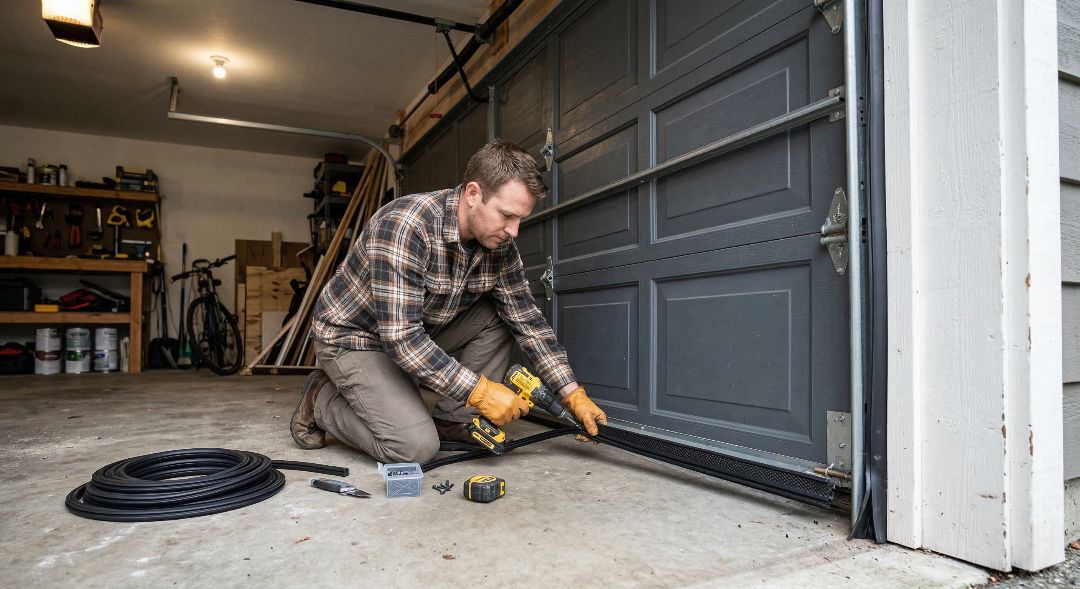
A middle-aged man in a brown plaid flannel shirt and work gloves kneels on a concrete garage floor, holding a drill to fasten a black rubber weatherstrip to the bottom of a grey, paneled garage door.
 

An overlooked benefit of a tight garage seal is the exclusion of unwanted guests. As temperatures drop, rodents and insects seek warmth, and even a 1/4-inch gap at the corner of a garage door is enough for a mouse to enter. EK Garage Door utilizes heavy-duty bottom seals and brush seals that are specifically designed to deter pests by closing the “gaps of opportunity” that common doors leave open.

Additionally, weatherstripping provides an excellent sound dampening effect. For Chicago residents living near the “L” train, busy intersections, or flight paths, the added density of professional seals can significantly reduce the transmission of street noise into the home.

The Importance of Professional Calibration

Installing weatherstripping is more complex than simply sticking tape to a frame. If the side seals are too tight, they increase friction on the door, which can cause the opener to burn out or the door to reverse unexpectedly. Conversely, if they are too loose, the energy-saving benefits are lost.

Our technicians at EK Garage Door perform a full system calibration with every seal replacement. We ensure that the door’s “limit settings” are adjusted so the door seats firmly against the threshold without over-compressing the rubber, which can lead to premature wear. We also check the balance of the door to ensure that the added seal friction hasn’t compromised the safety of the auto-reverse mechanism, a standard regulated by the Consumer Product Safety Commission (CPSC).


Optimize Your Chicago Home’s Thermal Shield Today

Don’t let your hard-earned money escape through the gaps in your garage door this winter. Weatherstripping is the most cost-effective way to improve your home’s energy efficiency, protect your property from moisture, and keep pests at bay. At EK Garage Door, we specialize in high-performance sealing solutions tailored specifically for the harsh Chicago climate. Our expert team will assess your door’s perimeter, threshold, and joints to provide a custom sealing plan that pays for itself in lower utility bills and increased comfort. Contact us today at (312) 860-1171 to book your energy-efficiency audit, start saving on your energy bills before the next cold front arrives.

How Seasonal Changes Affect Your Garage Door and What You Can Do About It

In a city like Chicago, the weather isn’t just a topic of conversation; it’s a force of nature that dictates how we maintain our homes. From the bone-chilling “Polar Vortex” winters to the humid, sweltering summers, the extreme temperature fluctuations of the Midwest place an enormous amount of stress on mechanical systems. Perhaps no part of your home bears this burden more than the garage door. As a massive, moving wall of steel, wood, or aluminum, it expands, contracts, and resists moisture 365 days a year. At EK Garage Door, we understand that a door operating perfectly in October might struggle by January. Understanding these seasonal shifts is the key to preventing costly emergency repairs and ensuring your home remains secure and energy-efficient year-round.

The Winter Impact: Metal Contraction and Lubricant Failure

A wide photograph of a two-car garage at twilight under snowy conditions, featuring a dark gray sectional door with unique small green rectangular light patterns.
 

Chicago winters are notorious for sub-zero temperatures that can wreak havoc on garage door hardware. The primary issue during the cold months is molecular contraction. Metal components, including the heavy-duty torsion springs, steel cables, and tracks, contract when the temperature drops. This contraction can cause the tracks to misalign or the springs to become brittle. In fact, most garage door springs snap during the first major cold snap of the year because the metal loses its elasticity and becomes prone to “fatigue snapping.”

Furthermore, standard lubricants can thicken or “gum up” in extreme cold, turning into a tacky substance that hinders rather than helps movement. This puts an immense strain on your garage door opener’s motor. According to the U.S. Department of Energy, maintaining the mechanical efficiency of home entry points is critical for reducing the overall energy load during peak heating seasons. If your door feels heavier or moves slower in December, it is likely a victim of winter-induced friction.

Spring Thaw: Moisture, Rust, and Foundation Shifts

As the snow melts and the spring rains arrive, a new set of challenges emerges. Moisture is the natural enemy of garage door longevity. For wooden doors, spring can lead to warping or rotting if the sealant has cracked. For metal doors, the primary concern is oxidation. The road salt used on Chicago streets often hitches a ride on your car and ends up on your garage floor. When this salt mixes with spring rain, it creates a corrosive brine that can eat through the bottom weather seal and begin rusting the bottom track and door panels.

Spring also brings shifts in the ground. As the frost heaves out of the soil, your garage floor or driveway may shift slightly. Because garage door tracks are precision-aligned to the millimeter, even a minor foundation shift can cause the door to bind or become “unbalanced.” The National Institute of Standards and Technology (NIST) emphasizes the importance of structural alignment in mechanical systems to prevent premature part failure. A quick professional balance test in the spring can prevent your opener from burning out due to these subtle environmental shifts.

Summer Humidity: Expansion and Sensor Misalignment

When the Chicago humidity hits in July and August, materials begin to expand. This is particularly problematic for the “photo-eye” safety sensors located at the base of your door tracks. The brackets holding these sensors can expand or shift in the heat, leading to misalignment. If your garage door starts to close and then suddenly reverses for no apparent reason, it is often due to the sun’s glare or heat-induced sensor drift.

High humidity also affects the electrical components of your garage door opener. Humidity can lead to condensation inside the motor casing, potentially shorting out circuit boards. Moreover, the heat can cause the wooden frames around the garage opening to swell, increasing the friction the door must overcome to open. Regular inspections during the warmer months ensure that your motor’s force settings are correctly calibrated to handle this seasonal resistance without compromising safety.

Autumn Preparation: The Vital “Pre-Winter” Audit

Autumn is the most critical time for garage door maintenance in Illinois. This is the window of opportunity to fortify your home before the harsh conditions return. A primary focus during the fall should be the weatherstripping. Over time, the rubber seals on the sides and bottom of your door become brittle. If these seals are not pliable, they will not create a “refrigerator-style” seal against the frame, allowing expensive heated air to escape.

As noted by the Office of Energy Efficiency & Renewable Energy, sealing gaps in the “building envelope” is one of the most cost-effective ways to lower utility bills. During an autumn tune-up, a professional technician will also apply a specialized silicone-based lubricant that is rated for low temperatures, ensuring that the moving parts remain fluid even when the mercury drops below zero.

The Critical Role of Professional Calibration

While many homeowners attempt DIY maintenance, the complexity of a garage door system, particularly the high-tension springs, requires professional expertise. A door that is off-balance by just a few pounds can shorten the life of a garage door opener by years. At EK Garage Door, we use specialized tools to measure spring tension and track plumbness, ensuring that the door is optimized for the specific weather patterns of the Chicago area.

Seasonal Maintenance Checklist for Chicago Homeowners:

  • Clear the Tracks: Ensure no ice, salt, or debris is built up in the metal tracks.
  • Test the Balance: Disconnect the opener and see if the door stays in place mid-travel.
  • Inspect the Seals: Look for light peeking through the edges of the door when closed.
  • Lubricate correctly: Use only professional-grade sprays; avoid thick grease that traps dirt.
  • Check Sensor Alignment: Keep the photo-eyes clean and pointed directly at each other.

Trust EK Garage Door to Protect Your Home Year-Round

Your garage door is a precision instrument that demands respect, especially given the volatile climate of the Great Lakes region. Neglecting seasonal changes doesn’t just lead to annoying squeaks; it leads to structural failures that can compromise your home’s security and your family’s safety. By choosing EK Garage Door, you are partnering with local experts who have spent years navigating the unique architectural and environmental demands of Chicago. We provide comprehensive seasonal tune-ups, emergency repairs, and high-efficiency installations designed to withstand 100-degree summers and sub-zero winters alike.

Secure Your Door Before the Season Shifts

Don’t wait for the next Chicago blizzard or summer heatwave to find out your garage door isn’t up to the task. Proactive maintenance is the most effective way to save money, improve energy efficiency, and ensure your daily routine is never interrupted by a broken spring or a jammed track. Whether you need a pre-winter safety inspection or a spring refresh for your weather seals, the team at EK Garage Door is standing by to provide the expert service you need. Contact us today at (312) 860-1171 to schedule your professional seasonal maintenance and ensure your home is ready for whatever the Chicago weather throws your way.