Blog

The Impact of Weather on Garage Doors

Chicago is world-renowned for its architectural beauty, but for homeowners, the city’s climate is a relentless adversary. From the humid, heavy air of a Lake Michigan summer to the brutal “Polar Vortex” winters, your garage door is on the front lines of every seasonal shift. Unlike interior doors, your garage door is a massive mechanical system that expands, contracts, and corrodes based on the forecast. At E.K. Garage Door, we have spent years studying how Chicago’s unique microclimates affect different door materials and components. Understanding these environmental stressors is the first step in ensuring your door remains functional and safe for years to come.

Winter: The Season of Mechanical Stress
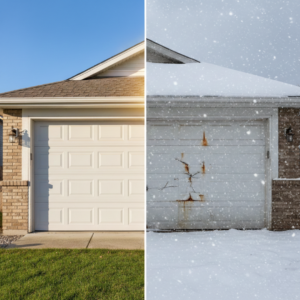
A side-by-side comparison showing a clean, white garage door in bright sunlight (left) and a rusted, cracked white garage door covered in snow during a winter storm (right).

In Chicago, winter isn’t just a season; it’s a mechanical stress test. When temperatures plummet below freezing, the physics of your garage door changes almost overnight. Metal components, including the torsion springs, tracks, and rollers, contract in the cold. This contraction can cause the door to bind in the tracks or put excessive strain on the opener motor as it tries to lift “stiff” hardware.

Why Springs Snap in the Cold

The most common emergency call we receive during a Chicago cold snap is for a broken spring. Metal becomes more brittle at low temperatures. When a spring that is already near the end of its life cycle is forced to lift a heavy door in sub-zero weather, the internal tension often exceeds the metal’s threshold, resulting in a loud “bang” and a door that won’t move. According to safety guidelines from the U.S. Consumer Product Safety Commission (CPSC), a failed spring can make a door a falling hazard, which is why we emphasize winter-ready inspections.

The Corrosive Duo: Road Salt and Melted Snow

Chicago’s commitment to clear roads means tons of salt are spread across the city. As you drive your vehicle into the garage, that salt-laden slush melts and settles into the bottom of your garage door panels, hinges, and cables. This creates a highly corrosive environment. Salt accelerates the oxidation process, leading to orange rust “pitting” on springs and the fraying of steel cables. If left untreated, this corrosion can lead to sudden cable failure, leaving your door dangerously lopsided.

Summer: Humidity, Warping, and Sensor Errors

While winter is about contraction and breakage, Chicago summers bring challenges related to expansion and moisture. High humidity levels, often exceeding 80% during July and August, can wreak havoc on both the structural and electronic components of your garage door system.

The Expansion of Wood and Steel

For homeowners with wooden garage doors, humidity is the primary enemy. Wood is a porous material that absorbs moisture from the air, causing panels to swell and warp. This expansion can cause the door to rub against the stop molding or become too heavy for the opener to lift smoothly. Even steel doors aren’t immune; extreme heat can cause metal panels to expand slightly, which may throw off the alignment of the tracks, leading to a “jerky” movement or strange grinding noises.

Infrared Sensor Interference

Summer heat can also lead to “phantom” reversals. The safety sensors (photo-eyes) at the base of your door rely on an infrared beam. During the longest days of the year, direct, intense sunlight can actually “wash out” the sensor’s signal, tricking the system into thinking there is an obstruction. This is a common frustration for Chicagoans whose garages face East or West. Research from Stanford University on Internet of Things (IoT) sensors indicates that environmental factors like heat and moisture are the leading causes of sensor inaccuracy in residential automation.

Wind Load: Surviving the “Windy City”

True to its nickname, Chicago experiences high-velocity winds that can put immense pressure on large exterior surfaces. A standard garage door is essentially a giant sail. If a door is not properly reinforced to meet local Wind Load requirements, a severe storm can actually blow the door inward or pull it out of its tracks.

The Federal Emergency Management Agency (FEMA) points out that the garage door is often the “weakest link” in a home’s structural envelope during high-wind events. If the garage door fails, it can lead to a sudden change in internal pressure that can lift the roof off the home. At E.K. Garage Door, we install doors that meet or exceed the International Code Council (ICC) wind-load standards, featuring reinforced struts and heavy-duty tracking to ensure your home stays sealed even during a gale.

Protecting Your Investment: Seasonal Solutions

Because we cannot change the Chicago weather, we must change how we maintain our doors. A “set it and forget it” mentality leads to expensive emergency repairs. We recommend a twice-yearly maintenance ritual to combat the impact of the elements.

  • Spring Cleaning: Wash the bottom of your door panels and your tracks with fresh water to remove accumulated road salt from the winter.
  • Lubrication: Use a low-temperature silicone-based lubricant on all moving parts. Unlike standard grease, silicone won’t thicken in the winter or attract dust in the summer.
  • Weather Seal Inspection: Check the rubber bottom seal for cracks or brittleness. A solid seal keeps out moisture, salt, and the humidity that causes wood to warp.

For those interested in the long-term energy impact of these weather changes, Iowa State University Extension provides excellent data on how thermal barriers like insulated garage doors can mitigate the effects of outside temperatures on your home’s interior climate.

Partner with Chicago’s Weather-Proofing Experts

You shouldn’t have to worry every time a storm rolls in or the temperature drops below zero. At E.K. Garage Door, we specialize in “Chicago-proofing” your garage. Our technicians are experts in identifying the subtle signs of weather-related wear before they turn into catastrophic failures. Whether you need a high-R-value insulated door to combat the cold, a wind-load reinforced system for storm season, or a professional salt-removal tune-up, we have the local expertise to get the job done right. Don’t let the elements dictate the life of your garage door. Contact us today to schedule a comprehensive weather-readiness inspection. We are proud to keep Chicago’s homes secure, no matter what the forecast says.
Preventative Garage Door Maintenance

Your garage door is more than just a convenience; it is a heavy-duty mechanical system that likely serves as the primary entrance to your home. In a city like Chicago, where lake-effect snow, sub-zero “Polar Vortex” snaps, and humid summers are the norm, your garage door faces a brutal environment. Without regular care, the combination of road salt, moisture, and extreme temperature fluctuations can lead to catastrophic failure. At E.K. Garage Door, we believe that preventative maintenance is the most cost-effective way to ensure your home remains secure and your daily routine remains uninterrupted.

The Chicago Climate Challenge: Why Maintenance Can’t Wait

Chicago’s unique weather patterns act as a constant stress test for garage door components. When temperatures drop, metal contracts. This physical shift can cause torsion springs to become brittle and tracks to fall out of alignment. Furthermore, the road salt used on Chicago streets often finds its way into your garage, accelerating the corrosion of steel cables and rollers.

According to data from the U.S. Department of Energy, a poorly maintained garage door can account for up to 25% of a home’s energy loss. Gaps in weatherstripping or a door that won’t seal properly allow Chicago’s biting winds to penetrate your home, forcing your HVAC system to work overtime. Regular tune-ups ensure that your door remains a thermal barrier, protecting both your utility bill and your vehicle.

The 10-Point Professional Maintenance Checklist

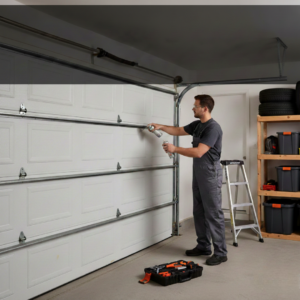
A male technician in grey overalls stands in a garage, using a spray lubricant on the hinges and rollers of a white sectional garage door.

While many homeowners attempt basic cleaning, a professional tune-up involves technical calibrations that require specialized tools and expertise. Our technicians perform a comprehensive 10-point inspection designed to catch “silent” issues before they turn into emergency repairs.

  1. Tightening of Hardware: A garage door moves up and down over 1,500 times a year on average. This constant vibration loosens the bolts on the tracks and hinges.
  2. System Lubrication: We apply high-grade silicone or lithium-based lubricants to all moving parts. Unlike standard grease, these formulas won’t thicken in -20°F weather.
  3. Spring Tension Calibration: Springs lose their “lifting power” over time. We adjust the tension to ensure the door remains perfectly balanced.
  4. Cable Inspection: We look for the “hidden” signs of fraying or oxidation that precede a snapped cable.
  5. Roller Assessment: We check for flat spots on nylon rollers or worn bearings in steel rollers that cause grinding noises.
  6. Track Alignment: We ensure the vertical and horizontal tracks are perfectly plumb to prevent the door from binding.
  7. Weather Seal Replacement: We inspect the bottom rubber seal and perimeter molding to block out drafts, moisture, and pests.
  8. Sensor Realignment: We clean and align the photo-eye safety sensors to prevent “phantom” reversals.
  9. Opener Force Adjustment: We calibrate the motor’s sensitivity so it doesn’t overwork itself against Chicago’s winter resistance.
  10. Battery Backup Testing: We ensure your system will still function during the inevitable lake-effect power outages.

Prioritizing Safety: The Moral and Financial Responsibility

A garage door is the largest moving object in your house, often weighing between 150 and 400 pounds. Safety isn’t just a suggestion; it is a legal and ethical priority. Research shared by Iowa State University highlights that professional maintenance is the leading factor in preventing the 20,000 to 30,000 garage-related accidents reported annually in the U.S.

Our maintenance service includes a rigorous UL 325 safety test. This includes testing the auto-reverse mechanism, ensuring the door reverses within seconds of touching an object, and verifying that the infrared sensors are mounted at the correct height to protect pets and small children. Neglecting these tests can lead to property damage or, worse, personal injury.

When to Schedule Your Tune-Up

In the Midwest, timing is everything. We recommend a professional maintenance visit at least once a year, ideally during the transition seasons:

  • The Fall Prep: Before the first deep freeze, ensuring your seals are supple and your lubricants are fresh prevents the common “frozen shut” door syndrome.
  • The Spring Thaw: After a long winter of salt exposure and heavy snow, a spring checkup identifies any parts that were weakened by the cold and prepares the door for the high-use summer months.

Homeowners who use their garage as their primary entrance (opening it 5+ times a day) should consider a bi-annual schedule. For more detailed safety standards regarding mechanical systems in residential buildings, you can consult the International Code Council (ICC).

DIY vs. Professional Maintenance: Knowing the Limits

There are several tasks a homeowner can handle safely, such as clearing debris from the tracks or wiping down the panels. However, the “heart” of the door, the torsion springs and cables, is under enough tension to cause fatal injury if handled improperly.

A professional technician from E.K. Garage Door brings “trained eyes.” We can hear a bearing that is about to seize or see a hairline crack in a hinge that a non-expert would miss. By spending a small amount on a routine tune-up, you potentially save thousands of dollars on a full door replacement or an emergency midnight service call when the door gets stuck halfway.

Join the E.K. Garage Door Maintenance Program

Don’t wait for a loud bang in the middle of the night to realize your garage door needs attention. Proactive care is the hallmark of a responsible homeowner and the best way to protect your investment. At E.K. Garage Door, we offer specialized maintenance packages tailored to the specific needs of Chicago residences. Our local technicians are familiar with the common failure points in your neighborhood and arrive equipped to handle any minor adjustments on the spot. Protect your home, your family, and your peace of mind by scheduling a professional tune-up today. Contact us today to book your appointment. Let us ensure your garage door is ready to face whatever the Chicago weather throws its way.


The Essential Benefits of Garage Door Insulation in Chicago

In a city defined by its “Windy City” reputation and bone-chilling winters, the garage is often the most significant source of thermal loss in a residential property. Many Chicago homeowners view their garage as a separate entity from their living space, but if you have an attached garage, it functions as a massive, uninsulated wall. E.K. Garage Door specializes in high-performance insulation solutions designed specifically for the Illinois climate. Upgrading to an insulated garage door is not merely a cosmetic choice; it is a strategic home improvement that impacts your utility bills, your vehicle’s health, and your home’s structural integrity.

The Science of Thermal Resistance: Understanding R-Value

When discussing garage door insulation, the most critical metric is the R-value. This measures the ability of a material to resist heat flow. In the context of Chicago’s extreme temperature swings, from sub-zero winter nights to humid 90-degree summer days, a high R-value is the difference between a garage that acts as a refrigerator and one that maintains a stable, tempered environment.

There are two primary types of insulation used in modern doors: Polystyrene and Polyurethane. Polystyrene is often used in double-layer doors and provides a solid baseline of protection. However, Polyurethane is a “spray-in” foam that expands to fill every crevice of the door’s interior, providing superior structural rigidity and a significantly higher R-value. According to energy efficiency guidelines from the U.S. Department of Energy, properly sealing and insulating the “envelope” of your home, including the garage, can lead to substantial reductions in annual heating and cooling costs.

Superior Energy Efficiency and Lower Utility Costs

An uninsulated metal garage door acts as a giant heat conductor. In the winter, it pulls warmth out of your home; in the summer, it radiates heat like an oven. For homes with bedrooms or living spaces located directly above or adjacent to the garage, this thermal transfer forces your HVAC system to work overtime.

By installing an insulated door, you create a thermal break that stabilizes the temperature inside the garage. This buffering effect means your furnace doesn’t have to fight a constant stream of cold air leaking through the garage-to-house door. Data from Purdue University’s engineering studies on building envelopes suggests that a tempered garage can keep adjacent rooms up to 10 to 20 degrees warmer in the winter, directly correlating to lower monthly energy expenditures.

Enhancing Structural Durability and Dent Resistance

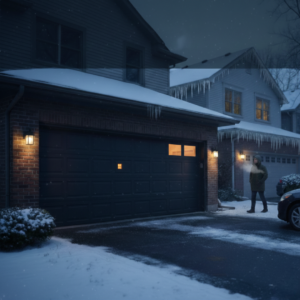
A dark, sectional garage door on a brick house at night during winter, featuring icicles on the roof and a person walking toward a car on a snow-covered driveway.

Chicago life can be tough on a garage door. From stray basketballs to the pressure of high-velocity winds off Lake Michigan, your door needs to be tough. Insulated doors are significantly more durable than their single-layer counterparts.

A standard single-layer door consists of a thin sheet of steel that is prone to “oil-canning” (warping) and denting. An insulated door, specifically a triple-layer construction, features a “sandwich” design where the insulation is packed between two layers of steel. This creates a much more rigid panel that can withstand impacts and high wind loads without buckling. For homeowners interested in the technical safety standards of these structures, the International Code Council (ICC) provides rigorous benchmarks for wind-load resistance and material integrity that E.K. Garage Door strictly adheres to.

The Advantage of Noise Reduction

The same materials that block heat also block sound. If you live on a busy Chicago street or near the “L” tracks, an uninsulated garage door can act as a drum, amplifying outside noise. The dense core of a polyurethane-insulated door absorbs sound vibrations, providing a much quieter environment. This is particularly beneficial for homeowners who use their garage as a workshop, gym, or home office.

Protecting Your Vehicle and Belongings

Your garage is likely home to your second most expensive investment: your car. Extreme cold is a primary enemy of vehicle longevity.

  • Battery Life: Cold temperatures slow down the chemical reactions inside a car battery, often leading to a “dead” car on the coldest mornings of the year.
  • Fluids: Thickened motor oil and frozen windshield wiper fluid put extra strain on your engine and components.
  • Tire Pressure: Drastic temperature drops cause air to compress, frequently triggering low-tire-pressure sensors.

An insulated garage generally stays 20 to 30 degrees warmer than the outdoor ambient temperature. This “buffer zone” ensures your car starts reliably and protects other sensitive items stored in the garage, such as paints, power tool batteries, and cleaning supplies, which can be ruined by freezing temperatures.

E-E-A-T: Why E.K. Garage Door is Chicago’s Choice

With years of experience serving the Chicago metropolitan area, the team at E.K. Garage Door understands the local architecture and the specific demands of our weather. We don’t believe in a one-size-fits-all approach. We conduct a thorough assessment of your garage’s orientation, usage, and existing insulation levels to recommend a door that provides the best return on investment.

Our technicians are experts in ensuring that the bottom seal and weatherstripping are perfectly calibrated with the new insulated door. Even the best insulation is useless if air is whistling through the gaps at the edges. We provide a comprehensive service that secures the entire perimeter, ensuring your home is a fortress against the elements.

Upgrade Your Chicago Home for Year-Round Comfort

Investing in garage door insulation is one of the smartest decisions you can make for your home’s efficiency and your own comfort. Whether you are looking to lower your ComEd bills, protect your vehicle, or finally turn that garage into a usable workspace, E.K. Garage Door has the expertise and the high-quality products to make it happen. Our team is ready to provide you with a transparent, detailed quote and help you select a door that matches both your home’s aesthetic and your performance needs. Don’t wait for the next Chicago polar vortex to realize your garage is a liability, contact us today to schedule a consultation. Let us help you keep the Chicago weather outside where it belongs.

How Smart Garage Door Openers Are Changing Home Security

The garage door is often the most overlooked entry point in a residential security strategy, yet for many Chicago homeowners, it is the primary gateway to the home. In 2026, the traditional “clicker” is becoming a relic of the past. As property crimes evolve, so too must our defenses. E.K. Garage Door is at the forefront of this shift, installing smart opening systems that transform a heavy slab of steel into a sophisticated, digital sentinel. These advancements are not just about convenience; they are fundamentally redefining what it means to have a secure home in the Chicago metropolitan area.

The End of “Code Grabbing” and Remote Theft

For decades, traditional garage door openers relied on fixed codes or simple transmission signals that tech-savvy intruders could easily intercept using “code grabbers.” Furthermore, a physical remote left on a car visor is a literal key to your home if your vehicle is ever broken into.

Smart openers eliminate these vulnerabilities through Security+ 2.0 and rolling code technology. Every time you operate your door via a smartphone, the system generates a unique, encrypted signal from billions of possible combinations. This ensures that the code used to open your door today will never work again. By shifting control to an encrypted smartphone app, homeowners eliminate the risk associated with lost or stolen physical remotes. For more information on the standards of encryption used in residential devices, the National Institute of Standards and Technology (NIST) provides extensive resources on digital security benchmarks.

Real-Time Vigilance: The Power of Instant Notifications

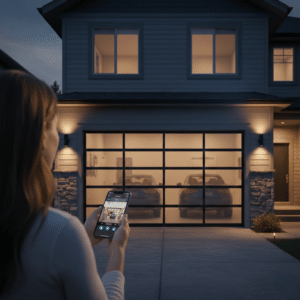
A woman holding a smartphone that displays a live video feed of her garage interior, with the actual glass-paneled garage door and two cars visible in the background at dusk.

The most significant psychological benefit of smart technology is the elimination of “opener anxiety.” We have all experienced the nagging doubt halfway through a commute: “Did I remember to close the garage?” With a smart system integrated by E.K. Garage Door, your house “talks” to you. If the door is opened, whether by a family member, a delivery driver, or an unauthorized person, you receive a push notification in real-time. This immediate awareness allows Chicago residents to contact authorities or neighbors instantly rather than discovering a breach hours later. Additionally, integrated activity logs provide a timestamped history of every opening and closing event, allowing you to monitor when your children arrive home from school or when service providers enter and leave the premises.

Visual Verification with Integrated HD Cameras

In 2026, the “smart” garage is also a “seeing” garage. Modern units from leaders like LiftMaster now feature built-in, motion-activated HD cameras with two-way audio. This changes the security dynamic from reactive to proactive.

  • Delivery Protection: With the rise of “porch piracy,” you can remotely open the garage for a delivery driver, watch them place the package inside, and close the door securely behind them, all while communicating through the opener’s speaker.
  • Facial Recognition: Advanced AI in newer models can distinguish between recognized family members and strangers, sending specialized alerts if an unknown individual is lingering near the threshold.
  • Environmental Awareness: High-definition video ensures that you can visually confirm if the door is obstructed or if a pet is in the way before you trigger a remote closing.

The U.S. Department of Justice frequently highlights that visible surveillance and recorded entry logs are among the strongest deterrents to residential burglary.

Geofencing and Automatic Closing

One of the most common ways burglars enter a home is through a door that was simply left open by mistake. Smart openers utilize geofencing technology to create a digital perimeter around your property. When your smartphone crosses this boundary, the system can automatically close the door for you. You can also set “Timer-to-Close” schedules, ensuring that if the door is still open at 10:00 PM, it secures itself automatically, providing a “set it and forget it” layer of protection that traditional motors simply cannot match.

Weather and Infrastructure Resilience

Chicago’s climate is a test of any mechanical system. Power outages during summer storms or extreme winter freezes can compromise electronic locks. Modern smart openers installed by E.K. Garage Doors come equipped with battery backup systems. This ensures that even when the Chicago power grid fails, your home remains secure and your primary entrance remains operational.

Furthermore, smart sensors can monitor the “health” of your door. If the system detects that the motor is straining due to a frozen track or a snapped spring, it will send a diagnostic alert to your phone. This allows you to address mechanical weaknesses before they become security loopholes. Research from Stanford University on the “Internet of Things” (IoT) suggests that predictive maintenance in home systems significantly reduces the long-term risk of catastrophic failure.

E-E-A-T: Why E.K. Garage Door for Your Smart Upgrade?

Installing a smart opener is as much about network security as it is about mechanical engineering. A poorly configured Wi-Fi connection can leave your home network vulnerable to hacking. Our technicians are not only experts in heavy hardware but are also trained in secure network integration. We ensure that your opener’s firmware is updated, your passwords are robust, and your app permissions are set to maximize privacy.

We serve the entire Chicago area with a commitment to transparency and technical excellence. We don’t just sell you a gadget; we provide a comprehensive security consultation to ensure your garage is the strongest link in your home’s defense.

Secure Your Future with a Smart Opener Today

The peace of mind that comes with total control over your home’s largest entrance is invaluable. In an era where home security is increasingly digital, upgrading to a smart garage door opener is one of the most effective and affordable ways to protect your family and your property. At E.K. Garage Door, we are ready to help you navigate the best technology for your specific needs, from belt-drive silent operators to heavy-duty industrial systems. Don’t leave your home’s security to a 20th-century clicker. Contact us today to schedule a professional installation. We are Chicago’s experts in making homes smarter, safer, and more secure one door at a time.