Blog

How to Fix a Garage Door Off Track

A garage door that has slipped from its tracks is more than a mechanical failure; it is a significant safety hazard that leaves your home vulnerable and your vehicle trapped. In the bustling neighborhoods of Chicago, a garage door is a primary entry point, and when it sits crooked or jammed, it presents an immediate crisis. At EK Garage Door, we have seen the damage that occurs when homeowners attempt to force a door back into place. This guide explains the mechanics of a door that has gone off-track, the immediate safety steps you must take, and how to identify when a professional intervention is the only safe path forward.

Understanding why a door leaves its tracks is the first step in prevention. Whether caused by a broken cable, a minor vehicular impact, or simple mechanical fatigue, an off-track door is under immense, uneven tension that can lead to a catastrophic collapse if handled incorrectly.

Why Garage Doors Slip Off Their Tracks

Several factors can lead to a garage door becoming unseated. Identifying the root cause is essential for a permanent fix, as simply popping the rollers back in will not solve the underlying structural instability.

Physical Impact and Obstructions One of the most common causes is a “fender bender” or hitting the door with a trash bin. Even a slight dent in a lower panel can shift the vertical alignment, causing the rollers to jump the track during the next operation cycle. Similarly, if an object, like a broom handle or a piece of sports equipment, gets caught in the track while the door is moving, the motor may continue to pull, forcing the rollers out of their designated path.

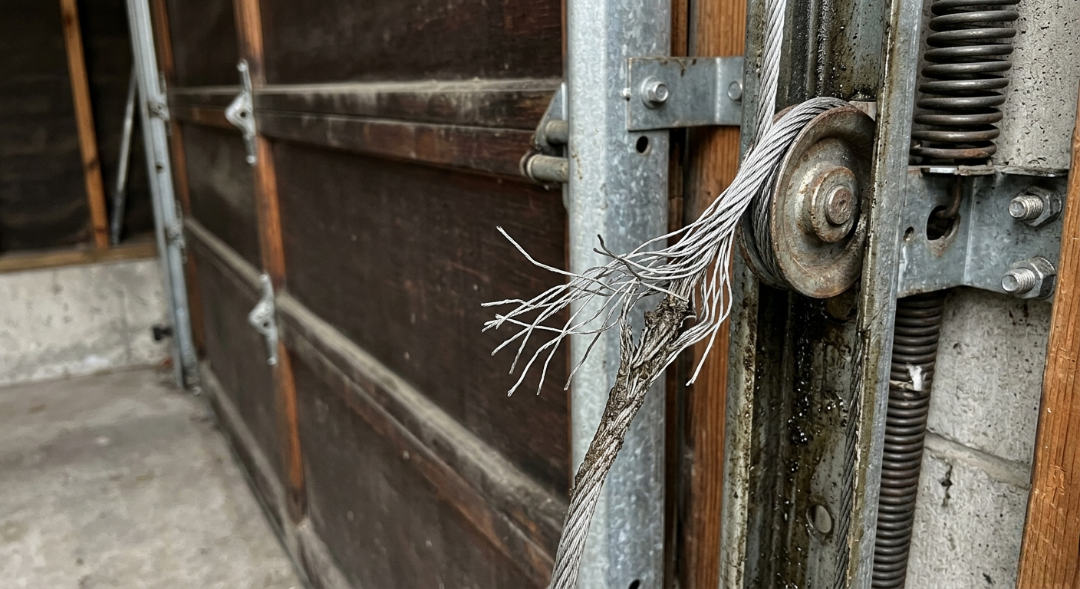
Broken Torsion Cables Garage doors rely on high-tension cables to lift and lower the heavy sections evenly. If one of these cables snaps or becomes frayed, the door will lose its balance instantly. The side with the functioning cable will continue to lift, while the other side drops, causing the door to sit at a dangerous angle. According to safety standards outlined by the Consumer Product Safety Commission (CPSC), cable and spring failures are leading causes of overhead door accidents.

Worn Rollers and Loose Hardware Over time, the rollers that guide your door can wear down or lose their lubrication, leading to increased friction. If a roller seizes, it can skid across the track instead of rolling, eventually popping out of the guide. Furthermore, Chicago’s extreme temperature fluctuations cause the metal tracks to expand and contract. This movement can loosen the mounting bolts that secure the tracks to the garage walls, leading to a “widening” of the tracks that allows the door to slip through.

Immediate Safety Protocol: What to Do First

If you look up and see your garage door hanging precariously by a single roller or sitting at an awkward tilt, stop all operation immediately.

Do Not Use the Electric Opener The most dangerous thing you can do is attempt to “power through” the problem using your remote. Modern openers are powerful; if the door is jammed and you trigger the motor, you risk burning out the gear kit, snapping the remaining cables, or pulling the entire track system off the ceiling. This can result in the door falling flat, potentially causing life-threatening injuries or crushing your vehicle.

Disengage the Motor Safely If the door is in the fully closed position, you can pull the red emergency release cord to disconnect it from the opener. However, never pull the release cord if the door is open or partially open. Without the motor’s carriage holding it in place, an off-track door may have nothing supporting its weight. If the springs are damaged, the door will fall like a guillotine the moment the release is pulled.

The Technical Reality of Repairing an Off-Track Door


At EK Garage Door, we approach an off-track situation with a focus on E-E-A-T (Experience, Expertise, Authoritativeness, and Trustworthiness). Repairing a door involves more than just physical strength; it requires a deep understanding of counterbalance physics.

Assessing Track Alignment and Verticality

Our technicians use precision levels to ensure the tracks are perfectly plumb. We don’t just put the rollers back; we inspect the tracks for “gapping.” If the tracks have moved, we must re-anchor them into the wall studs using heavy-duty lag bolts. For homes in Chicago, we often see tracks that have shifted due to the settling of older foundations or the vibration of nearby transit lines.

Cable Tension and Spring Calibration

Before a door can be re-tracked, the tension must be neutralized. We use specialized winding bars to safely manage the torsion springs, allowing us to reset the cables on their drums. Attempting to fix a cable without the proper tools is incredibly dangerous. These cables are under hundreds of pounds of pressure; if they slip, they can cause severe lacerations. You can learn more about the engineering of tensioned systems through resources at the National Institute of Standards and Technology (NIST).

Why This Is Rarely a DIY Project

While many home repairs are satisfying to complete yourself, an off-track garage door is one of the few instances where professional help is a necessity rather than a luxury. The primary reason is the risk of a total system collapse. When a door is off its track, its center of gravity has shifted. A single wrong move can cause the remaining rollers to fail, dropping the entire door.

Furthermore, a professional repair includes a comprehensive safety check. We inspect the “end bearings,” the “center bracket,” and the “rollers” to ensure that the reason the door went off-track is fully addressed. If you simply pop a door back onto a bent track, it will likely fail again within days, often with more violent results the second time around.

Preventive Maintenance: Keeping the Rollers in Line


Once your door is restored, maintaining it is the best way to prevent a recurrence. We recommend a “Search and Tighten” routine twice a year. Use a wrench to ensure the bolts holding the tracks to the wall are snug. Additionally, keep the tracks clean. Use a damp cloth to wipe away grease and road salt, which can cause the rollers to slip.

Lubrication is also key. Using a silicone-based or lithium-based spray on the rollers (but not inside the tracks themselves) ensures a smooth glide. Proper lubrication reduces the friction that leads to rollers jumping their guides.

Restore Your Home’s Security with EK Garage Door

A garage door that is off its tracks is a major disruption to your safety and your schedule. At EK Garage Door, we provide rapid-response, expert repairs designed to get your door back in alignment safely and efficiently. We understand the stress of a jammed door, and our Chicago-based technicians are equipped with the industrial tools and experience necessary to handle even the most complex mechanical failures. Don’t risk your safety or your property by trying to force a heavy overhead door back into place. Contact us today to schedule an emergency service call; we will ensure your door is properly balanced, securely tracked, and safe for your family to use.

How to Reset a Garage Door Keypad | Easy Step-by-Step

For many Chicago homeowners, the exterior keypad is the most convenient entry point to the home. Whether you are letting in a trusted neighbor, allowing your children to enter after school, or simply going for a jog without carrying keys, the keypad provides a seamless layer of accessibility. However, there are times when security needs to be updated or technical glitches occur, requiring a full system reset. At EK Garage Door, we understand that a malfunctioning keypad can disrupt your daily routine and compromise your home’s security.

Resetting a garage door keypad is a straightforward process, but it varies significantly depending on the brand and age of your opener. This guide provides a comprehensive walkthrough of the reset process, ensuring your home remains secure and your access remains uninterrupted.

Why You Might Need to Reset Your Keypad

Security experts generally recommend changing your access codes periodically to ensure long-term safety. If you have recently moved into a new home in the Chicago area, resetting the keypad should be one of your first priorities to ensure that previous owners or contractors no longer have access to your property.

Technical failures are another common reason for a reset. Over time, the synchronization between the keypad and the motor unit can drift due to power surges or battery depletion. Furthermore, if you find that your keypad is non-responsive or requires multiple attempts to register a code, a factory reset and reprogramming often resolve these underlying software “hiccups” without the need for expensive hardware replacement.

Identifying Your Garage Door Opener System

Before you begin the reset process, you must identify the manufacturer of your garage door opener. Most systems in the United States are manufactured by Chamberlain, LiftMaster, Genie, or Craftsman. The reset procedure is dictated by the logic board inside the motor unit, the box hanging from your garage ceiling.

A critical component to look for is the “Learn” button. On most modern units, this button is located under the light cover or on the rear panel of the motor. The color of this button (often yellow, purple, orange, or green) is not just aesthetic; it indicates the frequency and security technology (such as Security+ 2.0) that your system uses. Understanding these technical specifications is vital, as noted by the Federal Communications Commission (FCC), which regulates the radio frequencies used by residential garage door openers to prevent interference with other local signals.

The Standard Reset Process for Most Modern Units

For most systems produced in the last two decades, the reset process involves a two-step approach: clearing the old memory and programming the new code.

Clearing the Existing Memory

To erase all previous codes and remote signals, press and hold the Learn button on the motor unit for approximately six seconds. You will usually see an indicator light turn off or blink. Be aware that this action will also disconnect your hand-held remotes and car-integrated systems (like HomeLink). While this may seem like an inconvenience, it is the only way to ensure a complete security “blank slate.”

Programming the New Access Code

Once the memory is clear, you can program your new four-digit PIN. Press and release the Learn button again (do not hold it this time). Within 30 seconds, go to your exterior keypad and type in your chosen code, then press the Enter or Start button. The motor unit’s light will usually flash or make a clicking sound to confirm that the new code has been successfully paired.

Troubleshooting Common Keypad Issues

If the standard reset process does not work, the issue may be environmental or hardware-related rather than a programming error. Chicago’s extreme weather, ranging from sub-zero winters to humid summers, can take a toll on exterior electronics.

Battery Life and Connection The most frequent culprit for a “dead” keypad is a depleted 9-volt battery. Even if the keypad lights up, it may not have enough power to transmit a strong radio signal to the motor unit. We recommend replacing keypad batteries annually. Additionally, check the battery terminals for corrosion, which is common in high-humidity environments.

Signal Interference Electronic interference can occasionally prevent the keypad from communicating with the opener. According to resources from the National Institute of Standards and Technology (NIST) regarding wireless infrastructure, physical barriers like metal siding or interference from nearby LED bulbs and electronic devices can degrade signal strength. If your keypad works intermittently, try moving it a few inches or ensuring that the antenna wire on the motor unit is hanging straight down.

Safety and Security Protocols During Programming

A garage door technician in a navy blue uniform uses a screwdriver to service a wireless outdoor keypad mounted next to a dark wood-grain garage door, with a white service van visible in the background.
 

At EK Garage Door, we emphasize E-E-A-T (Experience, Expertise, Authoritativeness, and Trustworthiness) in every service we provide. When resetting your keypad, safety should be your primary concern. Ensure that the garage door path is entirely clear before testing your new code.

From a security standpoint, avoid using obvious codes like “1234,” your house number, or birthdays. These are the first combinations a potential intruder will try. If your keypad has a “temporary code” feature, use it for deliveries or service workers rather than giving out your primary PIN. This allows you to set a code that expires after a certain number of hours or uses, keeping your permanent code confidential.

When to Call a Professional Technician

While most keypad resets can be handled by the homeowner, certain situations require professional intervention. If you notice that the Learn button on your motor unit does not light up, or if the keypad refuses to sync despite new batteries and a clear memory, the logic board may have suffered a failure.

Logic board repairs involve sensitive electronic components and high-voltage wiring. Attempting to repair the internal circuitry of an opener can be dangerous and may void your manufacturer’s warranty. Our technicians at EK Garage Door carry universal keypads and OEM replacement parts, ensuring that we can restore your access quickly and safely without the guesswork.

Technical Maintenance for Longevity

To keep your keypad functioning perfectly after a reset, perform a quick maintenance check twice a year. Use a can of compressed air to blow out any dust or debris from between the buttons, as grit can cause the keys to stick or fail to register. If your keypad has a flip-up cover, ensure the hinges are moving freely and the cover snaps shut to protect the interface from Chicago’s wind-driven rain and snow.

Enhance Your Home’s Security with EK Garage Door

Your garage door keypad is the frontline of your home’s entry system, and ensuring it is programmed correctly is vital for your peace of mind. Whether you are struggling with an old unit that won’t sync or you want to upgrade to a modern, smartphone-integrated system, EK Garage Door is here to provide expert guidance and reliable service. We pride ourselves on helping Chicago residents maintain secure, efficient, and convenient homes through top-tier garage door technology. If you find that your keypad remains unresponsive after following these steps, or if you’re ready to upgrade to a more secure access system, contact us today to schedule a service visit with one of our expert technicians.

Why Garage Door Spring Adjustments Should Be Left to the Professionals

In the world of home maintenance, there is a clear line between tasks that are suitable for a weekend enthusiast and those that carry significant physical risk. While painting a wall or replacing a faucet is a manageable DIY project, garage door spring adjustment occupies a category of its own. At EK Garage Door, we have witnessed the aftermath of well-intentioned homeowners attempting to “tighten” or “balance” their own springs. The results often range from damaged property to severe personal injury.

Understanding the mechanics of a garage door system is essential for recognizing the hidden dangers within. Your garage door is likely the largest and heaviest moving object in your home, and the springs are the components that hold the literal weight of that system in a state of extreme tension.

The Physics of Tension: Why Springs Are Dangerous

To understand why a spring adjustment is so hazardous, one must understand the physics at play. A standard double-car garage door can weigh anywhere from 150 to over 400 pounds. The electric opener is not actually responsible for lifting this weight; rather, it simply guides the door. The heavy lifting is performed by the torsion or extension springs.

When a torsion spring is wound, it stores a massive amount of potential energy. This energy is what allows a person, or a small motor, to lift a heavy steel door with ease. However, that stored energy is also what makes the spring a “loaded weapon.” If a spring snaps or a winding bar slips during an adjustment, that energy is released instantaneously. According to safety reports from the U.S. Consumer Product Safety Commission (CPSC), garage door-related incidents account for thousands of emergency room visits annually, with a significant portion involving spring-related failures.

Common Signs Your Springs Need Adjustment

Before discussing the “how” of professional repair, it is important to identify the “when.” A garage door that is out of balance puts immense strain on the opener, the cables, and the rollers. If you notice any of the following symptoms, your springs likely require professional calibration:

  • The Door Feels Heavy: If you disconnect the opener and try to lift the door manually, it should stay in place when halfway open. If it slams shut, the springs have lost their tension.
  • Irregular Movement: A door that rises or falls unevenly or “stutters” during operation often has uneven tension across the two springs.
  • Excessive Noise: Loud squeaking, groaning, or a sudden “bang” (indicating a snap) are clear indicators of spring fatigue.
  • Slow Operation: If your motor is struggling more than usual to open the door, it is likely compensating for weak springs.

The Complexity of Torsion vs. Extension Systems

There are two primary types of spring systems used in Chicago homes, and each requires a specific set of tools and technical knowledge. Torsion springs are mounted on a metal rod above the door opening. Adjusting these requires specialized winding bars and a deep understanding of how many “quarter-turns” are necessary to achieve balance without over-stressing the metal.

Extension springs, found on the sides of the door tracks, act like giant rubber bands. While they may appear less intimidating, they are equally dangerous. If an extension spring breaks without a safety cable installed through its center, it can become a high-velocity projectile capable of piercing through drywall or car windows. Professionals ensure that all safety redundancies are in place before any adjustment begins.

The Professional Advantage: Expertise and Specialized Tools

A technician in a brown hoodie and jeans standing on a ladder working on the garage door tracks.

At EK Garage Door, our commitment to E-E-A-T (Experience, Expertise, Authoritativeness, and Trustworthiness) is demonstrated through our rigorous safety protocols. A professional technician brings more than just a wrench to the job; they bring years of localized experience dealing with the specific challenges of the Chicago climate.

Specialized Tooling

Professionals use non-slip winding bars specifically designed for the diameter of the spring’s winding cone. Homeowners often attempt to use screwdrivers or pliers, which are prone to slipping and causing the spring to unwind uncontrollably. We also utilize high-precision scales to measure the exact weight of the door, allowing us to calculate the precise torque required for a perfect balance.

Identifying Secondary Issues

A spring adjustment is rarely an isolated event. When our technicians evaluate a system, we look for frayed cables, worn bearings, and cracked rollers. Often, a homeowner thinks a spring needs tightening when, in reality, a bearing has seized. Adjusting the spring in this scenario would only mask a deeper problem that could lead to a total system collapse later.

Climate-Specific Calibration

Chicago’s extreme temperature fluctuations, from sub-zero winters to humid summers, cause metal to expand and contract. This environmental stress can lead to “metal fatigue.” Professionals understand how to calibrate springs to account for these shifts, ensuring the door operates smoothly regardless of the season. Information on the structural integrity of metals under stress can be further explored through materials science resources such as those provided by the National Institute of Standards and Technology (NIST).

The Financial Risk of DIY “Savings”

Many homeowners attempt DIY spring adjustments to save on service fees. However, the financial risk of a mistake far outweighs the cost of a professional call. If a spring is over-tightened, it can snap prematurely or cause the opener’s internal gears to strip. If the door falls due to an improper adjustment, the cost of replacing the entire door and the opener will be thousands of dollars more than a simple maintenance visit.

Furthermore, most garage door manufacturers void the warranty if the system is tampered with by an unlicensed individual. By hiring a professional, you protect your investment and ensure that any manufacturer warranties remain intact.

Prioritizing Household Safety

Beyond the risk to the person performing the work, an improperly adjusted door is a threat to everyone who uses the garage. A door that is not perfectly balanced can close with enough force to bypass the safety sensors’ auto-reverse function. This creates a significant entrapment hazard for children and pets. When a certified technician from EK Garage Door finishes a job, we perform a 25-point safety inspection to ensure that the “close-force” and “reversal” settings are functioning exactly as intended.

Trust EK Garage Door for Your Safety and Peace of Mind

Your safety is our primary concern. A garage door spring is a marvel of mechanical engineering, but it demands respect and professional handling. At EK Garage Door, we provide the expertise needed to keep your door running smoothly, quietly, and, most importantly, safely. Don’t risk a life-altering injury or a costly property repair by attempting to handle high-tension springs on your own. Contact us today to schedule a professional spring inspection and adjustment to ensure your home remains a safe and secure environment.

What to Do When Your Garage Door Won’t Close Properly

Discovering that your garage door refuses to close is more than just a minor inconvenience; it is a significant security risk and a safety hazard for your household. In a city like Chicago, an open garage door also means exposing your home to the unpredictable Midwestern elements and potentially skyrocketing your energy bills. At EK Garage Door, we have spent years diagnosing and resolving overhead door failures. This guide is designed to help you navigate the immediate steps to take, the safety protocols to follow, and how to identify when a simple fix has turned into a professional repair job.

Understanding the mechanics of your door is the first step toward a resolution. A garage door is a complex system of counterbalanced weights, sensitive electronics, and high-tension springs. When the system detects an abnormality, its default safety response is to remain open or reverse immediately.

Immediate Troubleshooting: The Photo-Eye Sensors

The most common reason a garage door won’t close, accounting for nearly 70% of service calls, relates to the electronic safety sensors, or “photo-eyes.” These small sensors are located near the floor on both sides of the door track. They project an invisible infrared beam across the opening; if that beam is broken, the door will not close as a primary safety measure.

Checking for Obstructions and Alignment The first thing you should do is ensure the path is completely clear. Sometimes a stray leaf, a child’s toy, or even a build-up of Chicago road salt can block the lens. If the path is clear, look at the LED lights on the sensors themselves. Usually, one is green and one is amber. If they are blinking or off, the sensors are misaligned. You can gently nudge them back into place until the lights glow steadily.

Cleaning the Lenses Because these sensors sit close to the ground, they are prone to getting dirty. Use a soft, dry cloth to wipe away dust or spiderwebs. Avoid using harsh chemicals that could cloud the plastic lens. Ensuring these sensors are functional is not just about convenience; it is a federal safety requirement. According to the Consumer Product Safety Commission (CPSC), all garage door openers manufactured after 1993 must include these entrapment protection features to prevent injuries.

Investigating Mechanical Obstructions and Track Issues

If the sensors are aligned and clear but the door still stops midway through its descent, the problem may be physical. A garage door travels along a set of tracks that must be perfectly parallel and free of debris to function.

Inspecting the Tracks and Rollers Over time, the vibration of the door can cause the mounting bolts on the tracks to loosen, leading to misalignment. If the track is even slightly bent or shifted, the rollers will bind, causing the motor to “sense” an obstruction and reverse. Visually inspect the length of the track for any pebbles, dried grease, or small objects that might be caught.

The Dangers of DIY Track Adjustment While it might be tempting to use a hammer to straighten a bent track, this often worsens the problem. The tracks are precision-aligned to support the weight of the door. An improper adjustment can cause the door to fall out of the tracks entirely, which is a catastrophic failure. If you notice significant bending or if the rollers are “popping” out of the track, it is time to call a professional.

Addressing Limits and Travel Settings

Your garage door opener has internal “limit settings” that tell the motor exactly how far to travel before it reaches the floor. If these settings are disrupted, often due to a power surge or a recent battery replacement, the door may hit the floor and immediately bounce back up, thinking it has hit an object.

Adjusting the Close Limit Most modern openers have adjustment screws or digital buttons on the motor head. These allow you to fine-tune the “travel” of the door. If the door reverses after touching the ground, the limit is likely set too low. However, adjusting these requires precision; if you set the force too high, the door will continue to push against the floor, which can damage the motor’s gear kit or the door’s bottom seal.

When the Problem is the Springs or Cables

If you hear a loud “bang” and the door refuses to move, or if the door appears lopsided as it tries to close, you are likely dealing with a broken torsion spring or a snapped cable. This is the most dangerous scenario for any homeowner.

Why Springs Are Critical The springs do the heavy lifting, not the motor. When a spring breaks, the motor is suddenly trying to move several hundred pounds of dead weight. You should never attempt to close the door manually if you suspect a broken spring. The tension held within these components is immense and can cause life-threatening injuries if handled without specialized tools.

For more information on the physical forces involved in overhead systems, you can refer to mechanical safety engineering resources provided by Occupational Safety and Health Administration (OSHA) regarding heavy machinery and tensioned systems.

Safety First: Using the Manual Release

If your door is stuck open and you need to secure your home before a technician arrives, you may need to use the manual release cord, usually a red rope hanging from the opener carriage.

The Proper Way to Pull the Cord Only pull the manual release when the door is in the fully closed position if possible. If the door is stuck open, be extremely cautious. If a spring is broken, pulling that card will cause the door to crash down with full force. At EK Garage Door, we always recommend having a second person assist you in slowly guiding the door down by hand once the motor is disengaged, ensuring no feet or fingers are near the bottom edge.

Why Professional Diagnosis Matters

Garage Door Needs Repair

At EK Garage Door, we pride ourselves on Experience, Expertise, Authoritativeness, and Trustworthiness (E-E-A-T). While DIY tips are helpful for minor sensor alignment, a garage door that won’t close often points to an underlying structural issue. Our technicians use specialized diagnostic tools to check the “balance” of the door. A perfectly balanced door should stay in place when left halfway open; if it falls or shoots up, the spring tension is incorrect, which will eventually burn out your opener.

We understand the Chicago landscape, from the humidity that swells wooden doors to the sub-zero temperatures that thicken garage door lubricant. We don’t just fix the symptom; we ensure the entire system is optimized for the local environment.

Secure Your Home with EK Garage Door

Leaving your garage door open is an invitation to unwanted guests and a drain on your home’s efficiency. If you have tried the basic troubleshooting steps and your door still refuses to close, do not risk your safety by forcing the mechanism. Our team of certified experts is ready to provide rapid, reliable, and transparent repair services to get your life back on track. We offer comprehensive inspections to ensure that once your door is closed, it stays that way. Contact us today to schedule an emergency repair and restore the security of your Chicago home.