Blog

Dealing with Chicagoland Humidity: How to Prevent Garage Door Mold and Warp

When people think of Chicago weather, their minds instantly drift to freezing winter blizzards and howling autumn winds. However, local homeowners know that Chicagoland summers bring an entirely different challenge: intense, heavy humidity. Driven by moisture evaporating off Lake Michigan and warm air masses moving up from the Gulf of Mexico, summer relative humidity levels in northern Illinois routinely spike into uncomfortable territory.

While we readily air-condition our main living spaces to stay comfortable, our garages bear the brunt of this airborne moisture. Left unchecked, high humidity creates a breeding ground for wood rot, structural warping, and toxic mold colonies inside your garage. Protecting your home requires a proactive strategy to safeguard your garage door panels and mechanical tracking system from seasonal moisture damage.

The Double Threat: How Humidity Warps and Breeds Mold

High humidity presents a dual threat to a garage door system, impacting both organic materials like wood and structural elements like insulation, weatherstripping, and metal fasteners. Understanding these two distinct processes helps reveal why early prevention is absolutely vital.

Structural Warping and Disalignment

If you own a natural wood garage door or an older composite door, moisture absorption is a constant threat. Wood is a hygroscopic material, meaning it naturally absorbs and releases water vapor from the surrounding air to match its environment. When relative humidity levels stay consistently high, the wood fibers expand unevenly.

This uneven expansion causes wood panels to twist, bow, or warp out of their original alignment. Even a slight structural warp can prevent the door from sitting flush against the frame, creating gaps that let in pests and water. Furthermore, a warped door places immense physical strain on the tracks and electric opener, often forcing the safety sensors to trigger or causing the door to jam entirely.

The Rise of Toxic Mold Colonies

Mold spores exist naturally in the air, but they require three specific conditions to settle and multiply: darkness, stagnant air, and a consistent moisture source. An unventilated Chicago garage in July provides the perfect incubator.

When hot, humid air enters a cooler garage, it reaches its dew point and condenses into liquid water droplets on the cool surfaces of the garage door panels, tracks, and springs. Once condensation forms on organic materials, such as wooden frames, drywall backing, or accumulated dust films, mold can develop within 24 to 48 hours. Beyond ruining the appearance of your garage door, airborne mold spores present serious respiratory risks to your family and pets.

High-Risk Areas in Your Garage Door System

Moisture does not distribute itself evenly. Because of airflow patterns and material properties, certain components of your garage door system are incredibly vulnerable to humidity-induced failure.

  • The Bottom Astragal and Weatherstripping: The rubber or vinyl seal at the base of your door naturally traps moisture underneath it against the concrete floor, making it the most common starting point for mold growth.
  • The Interior Backing Panels: Insulated doors that use low-grade vinyl or exposed polystyrene backing can collect microscopic pockets of condensation between the insulation and the outer metal skin, rusting the door from the inside out.
  • The Roller Bearings and Tracks: High humidity accelerates the breakdown of mechanical lubricants. As moisture mixes with track grease, it creates a sticky, abrasive paste that binds the rollers and leads to early hardware corrosion.

Proactive Strategies to Prevent Moisture Damage

You do not have to let Chicagoland’s volatile climate ruin your investment. Implementing a few strategic maintenance habits can drastically lower the humidity levels inside your garage and extend the lifespan of your door.

1. Maintain Exterior Protective Coatings

For wood garage doors, the absolute best defense is a flawless moisture barrier. Inspect your door annually for minor cracks, peeling paint, or fading stain. Every two to three years, apply a fresh coat of high-quality, exterior-grade, water-resistant paint or a UV-blocking polyurethane sealant. Ensure you seal all six sides of each panel, including the top, bottom, and side edges, as moisture readily penetrates raw, exposed wood seams.

2. Upgrade Your Ventilation and Climate Control

Stagnant air is mold’s greatest ally. Installing passive ridge vents, soffit vents, or an active exhaust fan can encourage continuous airflow, pulling hot, humid air out of the garage before it has a chance to condense. If you utilize your garage as a workshop, gym, or living space, running a dedicated, energy-efficient dehumidifier during the peak summer months is a highly effective way to keep relative humidity below the critical 50% threshold.

3. Replace Worn Weather Seals

Over time, summer heat and winter frost cause rubber weatherstripping to crack, flatten, and lose its elasticity. Damaged perimeter seals allow humid air and driving rain to leak directly into the garage enclosure. Upgrading to heavy-duty, commercial-grade vinyl seals around the top and sides of your garage door creates an airtight envelope, keeping external outdoor humidity exactly where it belongs, outside.

How to Safely Clean Mold and Address Warping

If you walk into your garage and spot black, green, or fuzzy white patches on your garage door system, you must act quickly to neutralize the fungus before it destroys the underlying material.

To clean surface mold safely, mix a solution of one cup of household white vinegar with one gallon of warm water. Vinegar is a mild acid that effectively penetrates the porous structure of wood and drywall to kill mold at the root without releasing toxic fumes. Scrub the affected panels thoroughly using a soft-bristle nylon brush, wipe the area clean with a damp microfiber cloth, and use a portable fan to dry the surface completely. For heavy infestations or properties dealing with severe indoor environmental moisture issues, you can consult mold remediation and structural safety guidelines managed by the U.S. Environmental Protection Agency (EPA).

If your door has already suffered significant structural warping, DIY fixes are generally ineffective and dangerous. Attempting to bend a warped panel back into place can crack the material or cause a high-tension spring to snap. For detailed statistics on structural engineering hazards and residential property safety standards, refer to data compiled by the U.S. Consumer Product Safety Commission (CPSC).

Professional Garage Door Protection in Chicago

Do not let oppressive summer humidity compromise the safety, structural integrity, and curb appeal of your home. If your garage door is sticking, showing signs of wood rot, or suffering from humidity-related mechanical strain, the expert team at EK Garage Door is here to help. Our certified technicians possess deep expertise in Chicago’s unique climate challenges and provide comprehensive moisture-resistance inspections, precision track realignments, and premium weatherstripping replacements. We offer a gorgeous selection of modern, moisture-resistant composite and insulated steel garage doors designed to perfectly mimic the elegant beauty of real wood without any of the risks of warping, rotting, or mold growth. Contact us today to schedule your professional system tune-up and ensure your home remains protected through every seasonal shift.

Wind Load Ratings: Is Your Garage Door Ready for Chicago’s Severe Storms?

Chicago is known worldwide as the “Windy City,” but local homeowners know that this nickname is more than just historical lore. Throughout the year, the Chicagoland area faces severe weather patterns, ranging from high-velocity lake-effect winds and intense summer thunderstorms to violent microbursts and tornadic activity. While we routinely secure our windows and reinforce our roofs, one of the most structurally vulnerable points of any home is often completely overlooked: the garage door.

As the largest moving opening on a residential structure, a garage door is subjected to immense physical pressure during a severe storm. If a door fails under the force of extreme winds, it can cause a catastrophic structural failure of the entire home. Ensuring your home is protected requires an understanding of structural wind load ratings and whether your current garage door is truly engineered to withstand Chicago’s volatile climate.

The Aerodynamics of Structural Failure During a Storm

A technician in blue overalls standing on a silver step ladder to repair a garage door motor above a white garage door at night.

To understand why a wind-rated garage door is so critical, it helps to examine the structural physics of a high-wind event. When severe storms hit, they create two distinct types of pressure on a building: positive pressure and negative pressure. Positive pressure occurs when the wind blows directly against the exterior face of the garage door, pushing it inward. Conversely, negative pressure acts as a vacuum, pulling the door outward as wind rushes past the sides and roof of the house.

If a non-reinforced garage door buckles or is blown off its tracks under these forces, the sudden breach fundamentally alters the pressure dynamics of the entire house. High-velocity air rushes into the garage, creating powerful internal positive pressure. Simultaneously, the storm winds rushing over the roof create severe negative lifting pressure. This combination acts like a balloon inflating inside your home, frequently lifting the roof right off the load-bearing walls and causing the residential structure to collapse from the inside out.

Decoding Wind Load Ratings and Building Codes

Because of these structural risks, building codes dictate specific structural requirements for garage doors based on regional weather patterns. A garage door’s wind load rating indicates the amount of positive and negative pressure (measured in pounds per square foot, or PSF) and the maximum wind speed (measured in miles per hour, or MPH) the door can safely withstand without failing.

In the Chicago metropolitan area, building codes generally align with standards established by the International Code Council (ICC). Depending on the specific municipality, location topography, and proximity to Lake Michigan, residential garage doors are typically required to withstand wind speeds starting at 90 to 115 MPH.

When looking at a wind load label on a garage door, you will see a designation like “W-1” or “W-5.” Higher numbers indicate the door features superior internal reinforcement, heavier gauge steel tracks, sturdier rollers, and robust U-bar reinforcement struts running horizontally across the interior panels. These components work together to distribute the physical load across the entire structural framing of the garage opening rather than concentrating it on the door panels.

How to Determine If Your Current Door Is Storm-Ready

Many homeowners inherit their garage doors when purchasing a home and have no idea if the system is properly rated for severe weather. You can evaluate your door’s readiness by checking for a few key indicators:

1. Locate the Certification Label

Every properly engineered, wind-rated garage door must display an official manufacturer’s label on the inside of one of the door panels. This sticker explicitly states the door’s model number, the design pressures it can handle (e.g., +22/-25 PSF), and compliance with testing standards like those governed by the Federal Emergency Management Agency (FEMA) for residential wind resistance. If your door lacks this sticker or it has been painted over, it is highly likely a standard, non-reinforced model.

2. Inspect the Internal Hardware

Open your garage door and look at the back of the panels. A wind-load-rated door will feature permanent, heavy-duty horizontal steel struts attached to every section. Additionally, the tracks running along the walls will be constructed from a thicker gauge steel, and the hinges holding the panels together will be heavy-duty, double-end hinge systems designed to lock the rollers securely into the tracks during a high-pressure event.

3. Evaluate the Age and Material

Older wood or single-layer uninsulated steel doors lack the structural rigidity required to pass modern wind load tests. Over decades of service, these materials degrade, develop micro-cracks, or suffer from hardware fatigue. If your door is more than 15 to 20 years old, it is highly vulnerable to warping and buckling when subjected to severe thunderstorm drafts.

The Benefits of Upgrading to a High-Wind Rated Door

Upgrading to a certified wind-load-rated garage door provides benefits that extend far beyond simple storm protection. First, the reinforced steel struts and thicker gauge hardware make the door incredibly rigid, which drastically reduces the everyday wear and tear on your electric opener and springs.

Second, because wind-rated doors require heavy-duty construction, they almost always feature high-quality polyurethane insulation layers. This dual-layer or triple-layer construction significantly improves your garage’s thermal efficiency, keeping your home warmer during harsh Chicago winters and lowering your energy bills. Finally, many premier home insurance providers offer premium discounts to homeowners who proactively upgrade to wind-resistant entry doors, recognizing that the upgrade substantially lowers the risk of catastrophic property damage claims.

Protect Your Chicagoland Home with EK Garage Door

Do not wait for the next severe storm warning to find out if your garage door can withstand Chicago’s intense wind pressures. Protecting your family, your vehicle, and your entire home starts with a professional structural assessment from the local experts at EK Garage Door. Our certified technicians possess deep expertise in local Illinois building codes and will thoroughly inspect your current door panels, tracks, and reinforcement hardware to ensure your system is completely storm-ready. We offer a premium selection of high-wind rated, fully insulated garage doors engineered to seamlessly blend superior aesthetic curb appeal with maximum structural durability. Contact us today to schedule your professional wind-load evaluation or to explore our durable storm-resistant upgrade options.

The Hidden Danger of Road Salt: How It Ruins Your Chicago Garage Door (and How to Fix It)

Chicago winters are notorious for demanding heavy use of road salt and chemical de-icers to keep our streets and driveways safe. While these melting agents are essential for vehicular traction and pedestrian safety, they bring a hidden, highly destructive consequence to your residential property. Every time you drive your car into your garage during the winter, your tires and undercarriage carry a heavy slush compounded with road salt directly inside.

As this frozen mixture melts, it creates a highly corrosive briny puddle that rests against the base of your garage door. Over time, this chemical exposure causes severe, quiet destruction that compromises both the aesthetic appeal and structural integrity of your garage door system. Understanding how road salt interacts with your door materials is the first step toward preventing expensive structural failures.

The Chemical Reaction: How Salt Attacks Garage Door Materials

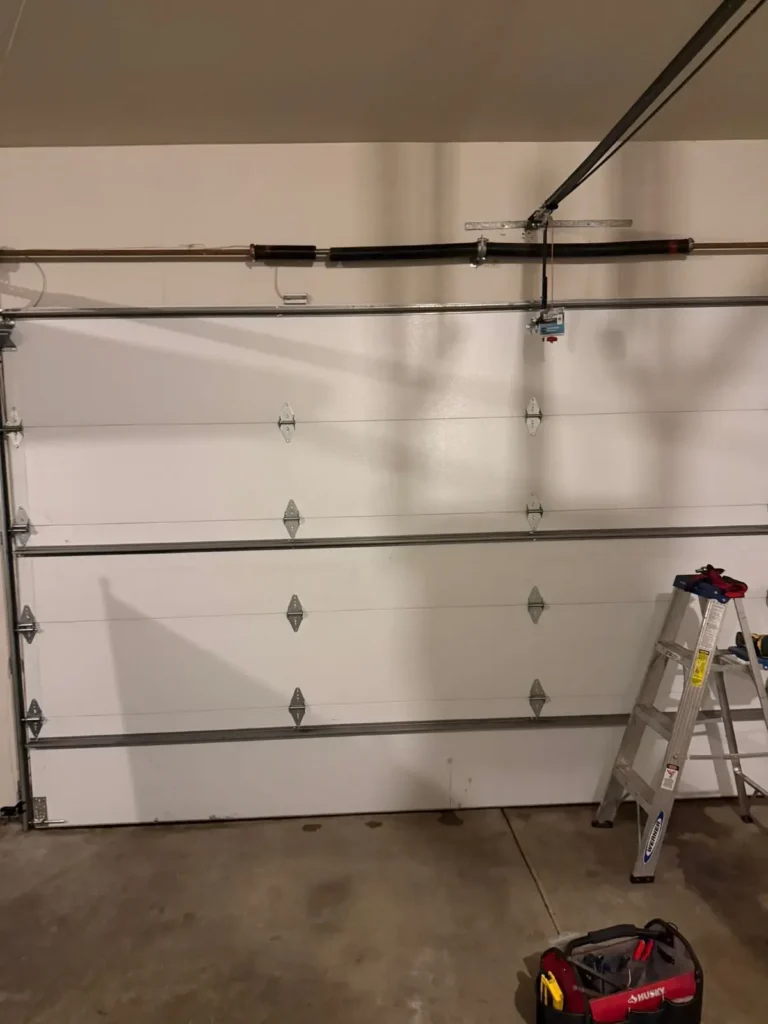
A wide shot of a white four-panel garage door inside a garage with a step-ladder positioned to the right.

The road salt used by municipal fleets across Illinois is primarily composed of sodium chloride, often blended with calcium chloride or magnesium chloride. These chemical compounds are highly effective at lowering the freezing point of water, but they are also incredibly aggressive corrosive agents.

When salt water comes into contact with bare or poorly protected metal surfaces, it acts as an electrolyte. This significantly accelerates the oxidation process, which converts steel into iron oxide, commonly known as rust. Most modern garage doors are constructed from galvanized steel, which features a thin protective layer of zinc. However, prolonged exposure to road salt chemically strips this zinc coating away. Once the protective barrier is breached, the underlying steel begins to blister, rust, and eventually rot through completely, leaving the bottom of your door brittle and structurally unstable.

Critical Areas Vulnerable to Salt Damage

Salt damage is rarely confined to a single spot. Because of how water pools and splatters, several key components of your garage door system are at severe risk during a typical Chicago winter.

1. The Bottom Door Panel

The very bottom section of your garage door takes the brunt of the chemical assault. As you park your vehicle, salt-laden slush drips off the wheel wells and collects on the garage floor, directly contacting the interior face of the bottom panel. Externally, wind-blown salt spray from the street coats the exterior face. This dual-sided exposure causes the paint to bubble, peel, and flake away, revealing unsightly orange and brown rust streaks along the bottom perimeter of your home’s facade.

2. Torsion and Extension Springs

Many homeowners do not realize that road salt can impact the internal mechanical components of their garage door. When you open a wet garage door, the panels track overhead, and salt-heavy moisture can drip onto the high-tension springs mounted above or to the sides of the door. The steel used in garage door springs is highly sensitive to corrosion. Rust creates microscopic pits along the surface of the spring coils, which act as stress concentration points. Under the immense mechanical tension required to lift the door, a rusted spring is significantly more likely to snap prematurely, creating an immediate safety hazard.

3. Track Assemblies and Roller Bearings

The vertical steel tracks that guide your door up and down sit directly on the concrete garage floor, making them highly susceptible to pooling salt water. As the bottom of the tracks corrode, they can warp or lose their alignment, causing the door to bind, shake, or jam during operation. Additionally, salt dust and brine can easily penetrate the unsealed bearings of your garage door rollers, drying out the internal lubrication and causing the rollers to seize up entirely.

Practical Steps to Prevent and Fix Salt Damage

Protecting your investment against chemical corrosion requires a combination of proactive winter maintenance and targeted restorative fixes.

1. Establish a Regular Wash Routine

Do not wait for spring to clean your garage door. On days when winter temperatures climb above freezing, take a few minutes to rinse the bottom three feet of your garage door panels, tracks, and weatherstripping with a garden hose or a bucket of warm, soapy water. Using a mild car wash detergent helps neutralize and lift the salt film without stripping away the door’s protective wax finish.

2. Clean and Seal Your Garage Floor

To stop salt brine from pooling against the interior door components, sweep out standing slush and water daily using a heavy-duty push broom. For long-term protection, consider coating your concrete garage floor with a specialized polyurea or epoxy sealant. According to materials research published by institutions like the University of Illinois Urbana-Champaign (UIUC), sealing concrete surfaces prevents the absorption of corrosive chlorides, making it much easier to wash away salt residue before it migrates to your metal fixtures.

3. Repair Minor Rust Immediately

If you catch rust early before it punctures the steel panel, you can stop it from spreading. Lightly sand the affected area with fine-grit sandpaper to remove the loose rust flakes down to bare metal. Wipe the area clean with rubbing alcohol, apply a high-quality zinc-rich rust-inhibiting primer, and topcoat it with an exterior-grade paint that matches your door’s original color.

4. Regularly Inspect Product Integrity

Ensure your bottom rubber weather seal is intact and making tight contact with the floor to block salt spray from blowing inside. For more information on structural household hazards and product testing guidelines regarding home entryways, you can refer to safety alerts published by the U.S. Consumer Product Safety Commission (CPSC).

Professional Winterization and Garage Door Repair

Regular maintenance goes a long way, but if road salt has already caused deep structural rust, warped your tracks, or corroded your high-tension springs, DIY fixes can put your safety at risk. The expert team at EK Garage Door is here to restore the safety and curb appeal of your home. Our certified technicians specialize in identifying hidden salt damage, replacing compromised bottom panels, installing heavy-duty corrosion-resistant hardware, and performing comprehensive winter tune-ups across the entire Chicago area. Do not let winter weather shorten the lifespan of your garage door system, contact us today to schedule your professional inspection and ensure your door remains reliable, secure, and beautiful all year long.

How Smart Garage Door Openers Are Changing Home Security

For generations, the residential garage door served a straightforward, entirely mechanical purpose: it was a heavy wall of steel or wood that rolled up to let your vehicle in and rolled down to keep the weather out. Unfortunately, this simplicity also made it one of the most glaring security vulnerabilities in the modern household. Burglars have long viewed the garage as a preferred point of entry, offering both a large target and an easy way to slip inside a home completely shielded from public view.

The integration of Internet of Things (IoT) technology has fundamentally changed this landscape. Modern smart garage door openers have transformed these heavy mechanical barriers into intelligent, active components of a comprehensive home security ecosystem. By replacing primitive radio transmitters with encrypted cloud networks, real-time tracking, and automated access control, smart openers are completely redefining how homeowners protect their properties.

The Vulnerabilities of Traditional Garage Systems

To appreciate the security leap that smart technology represents, it is necessary to examine the flaws inherent to traditional automatic garage door openers. Standard systems rely on a physical remote control transmitting a radio frequency signal to the motor unit. While older fixed-code systems have mostly been replaced by basic rolling codes, traditional remotes can still be lost, stolen from unlocked vehicles parked in driveways, or duplicated by sophisticated criminals using signal-grabbing devices.

The greatest security risk to a traditional garage door is simple human error. It is incredibly easy to drive away in a morning rush and completely forget to check if the door closed all the way behind you. Similarly, family members might leave the door open overnight by mistake. According to residential security assessments compiled by the King County Sheriff’s Office, an open or unlocked garage door remains the single most common invitation for opportunistic property theft. Once an intruder gains access to the garage interior, they can work at their leisure to breach the interior pedestrian door leading into the main living spaces.

Active Security: The Core Features of Smart Openers

Smart garage door openers eliminate the guesswork and structural vulnerabilities of traditional systems by shifting from a passive mechanical model to an active, data-driven security approach.

Real-Time Alerts and Complete Activity Logs

The foundational benefit of a smart opener is the continuous, bidirectional communication between the garage motor and your smartphone. Instead of wondering if your door is securely shut, the dedicated application provides a real-time status indicator accessible from anywhere in the world.

If the garage door is opened, whether by a family member, a delivery driver, or an unauthorized intruder, your phone receives an immediate push notification. Furthermore, the system maintains a digital activity log detailing precisely what time the door was activated and which specific user credential triggered the event. This level of oversight provides undeniable peace of mind, allowing you to audit access to your home over days, weeks, or months.

Geofencing and Automated Closing Protocols

One of the most innovative security advancements is geofencing technology. By utilizing your smartphone’s built-in GPS, a smart garage system can establish a digital perimeter around your property. If you drive past this boundary and the system detects that the garage door is still open, it can automatically close the door for you or send an urgent reminder to your device.

Additionally, homeowners can configure custom timing rules. For example, you can set a rule stating that if the garage door remains open for more than fifteen minutes between the hours of 10:00 PM and 6:00 AM, the motor will automatically lower the door and engage its locking mechanisms.

Cyber-Physical Network Encryption

Because smart openers operate over your home’s Wi-Fi network, manufacturers prioritize elite digital security protocols. Modern smart openers utilize advanced end-to-end encryption to safeguard wireless transmissions against hacking. Research from the Stevens Institute of Technology emphasizes that modern IoT ecosystems rely on automated behavioral cross-checks and encrypted data streams to prevent malicious third-party overrides. This ensures that a digital intruder cannot simply copy your wireless signal or execute an unauthorized command to force your garage door open.

Integration into the Broader Smart Home Ecosystem

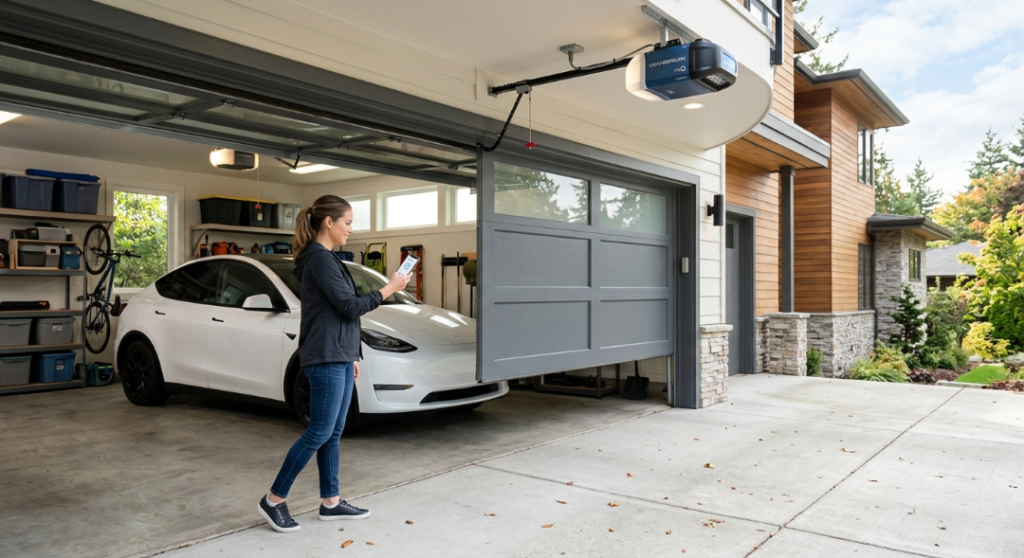
A woman stands on a concrete driveway holding a smartphone, looking toward a modern two-story home as its gray garage door rolls open to reveal a parked white Tesla.

Smart garage door openers do not operate in a vacuum; their security value multiplies when they are integrated into a larger home automation framework. By linking your opener to platforms like Apple HomeKit, Google Home, or Amazon Alexa, you can create cohesive safety routines that respond dynamically to potential threats.

+——————————————————-+

|             SMART GARAGE DOOR ACCESSED                |

+——————————————————-+

                           |

                           v

+——————————————————-+

|          CENTRAL HOME AUTOMATION FRAMEWORK            |

+——————————————————-+

                           |

         +—————–+—————–+

         |                                   |

         v                                   v

+——————+               +——————+

|  SMART LIGHTING  |               |  CAMERA NETWORK  |

| Activates path & |               | Begins high-res  |

| interior lights  |               | video recording  |

+——————+               +——————+


For instance, you can program a setting where opening the garage door after sunset automatically triggers your outdoor floodlights and unlocks the interior mudroom deadbolt. Conversely, arming your main home security system when you leave for work can automatically signal the garage door to lock down and ignore all physical remote control commands until you return and authenticate via biometrics on your phone.

Eliminating Key Management Risks with Digital Tokens

Traditional home security often breaks down at the point of access delegation. Handing over physical house keys or revealing the master PIN to your outdoor garage keypad to contractors, dog walkers, or houseguests creates a permanent security loophole.

Smart garage doors elegantly resolve this issue by allowing you to generate temporary digital access tokens. Through the app, you can grant specific individuals permission to open the door only during designated windows of time, such as every Tuesday between 2:00 PM and 4:00 PM. Once that timeframe expires, their access is automatically revoked without you ever needing to change a physical lock or master code. Many smart systems also integrate directly with secure in-garage delivery services, allowing verified couriers to open the door just a few feet to place packages safely inside, protecting your high-value deliveries from porch pirates.

The Imperative of Professional Implementation

Transitioning your home to a smart garage setup requires more than just downloading an app; it demands a flawless marriage of digital configuration and heavy-duty physical engineering. A smart sensor cannot secure your home if the underlying tracking is warped, the torsion springs are failing, or the motor is improperly calibrated. Entrusting your upgrade to a professional garage door repair and installation service guarantees that your physical hardware is perfectly balanced, the safety reverse mechanics are fully compliant with federal standards, and your wireless network configuration is fully optimized to prevent signal dead zones.

Upgrade Your Chicago Home Security with EK Garage Door

The era of relying on passive, unpredictable mechanical garage door openers to protect your family and your investments is over. At EK Garage Door, we are dedicated to bringing the absolute best in modern smart home innovation to homeowners throughout the greater Chicago region. Our team of experienced, fully licensed technicians understands the unique security demands of urban and suburban households alike, and we possess the deep technical expertise required to seamlessly install, program, and maintain advanced smart entry systems. Whether you are looking to retrofit your existing garage system with intelligent connectivity or want to install a brand-new, ultra-quiet smart opener complete with integrated video surveillance, we provide tailored, reliable solutions that place total control right in the palm of your hand. Contact us today to schedule a comprehensive security consultation and professional installation estimate.