


In a fast-paced industrial hub like Chicago, your warehouse operations rely heavily on seamless supply chain movement. From the massive logistics centers near O’Hare and the Midway corridors to the manufacturing facilities across Cook County, efficiency is the lifeblood of profit. At the center of this physical flow stands your loading dock.
Your commercial overhead garage doors are the literal gatekeepers of your inventory, security, and climate control. When a commercial door fails, it isn’t just an inconvenience, it is an operational bottleneck that stalls transit trucks, compromises employee safety, and bleeds money by the minute.
Because industrial garage doors operate under extreme mechanical tension and cycle dozens of times daily, they exhibit specific warning behaviors before suffering a catastrophic breakdown. Recognizing these five primary indicators early allows you to schedule commercial garage door repair before a total operational shutdown impacts your bottom line.
1. Speed Fluctuations and Delayed Response Times
Industrial overhead doors are specifically engineered to open and close at quick, uniform speeds to optimize logistical throughput and maintain energy parameters. If you press the activation console or pull-cord switcher and notice a distinct lag before the door reacts, the electronic control board or mechanical hoist is struggling.
More critically, keep a close watch for jerky, uneven movement or speed variations as the door travels along the vertical tracking. If the door panel shoots up quickly but crawls painfully slow on the descent, or vice versa, the system is dangerously out of balance. This behavior indicates that the high-performance motor operator is attempting to muscle through a failure in your counter-balance system, placing extreme torque on the drive chains and gear reducers.
2. Visible Deflection, Sagging, or Panel Realignment
Industrial facility environments are highly vulnerable to localized structural accidents. Forklifts, pallet jacks, and delivery box trucks maneuver in tight spaces, making accidental impact with loading dock doors a common occurrence.
Even a seemingly minor ding from a forklift can compromise the structural integrity of a heavy sectional steel panel. Take a look at the door while it is in a completely closed position. If you notice any horizontal sagging along the middle spine, or if individual sections look visibly twisted, the internal reinforcing struts have buckled.
Operating a door with bent or misaligned panels forces the roller wheels to twist sideways within the vertical tracks. This binding effect can strip the rollers out of their hinges, warp the metal tracks out of plumb, or cause a catastrophic track derailment that leaves a multi-hundred-pound door hanging precariously over an open bay.
3. High-Friction Noise Profiles: Grinding, Screeching, or Scraping
Warehouses are naturally loud environments, but a failing overhead door will easily pierce through the standard ambient factory drone. A properly calibrated, well-lubricated industrial door should glide smoothly with a rhythmic mechanical sound.
If your loading dock area is suddenly filled with a sharp, metal-on-metal screeching, a heavy grinding sound, or intense rhythmic thudding, the system is actively wearing itself down.
- Screeching or Scraping: Typically indicates that the steel track channels have narrowed, or the precision ball bearings inside the commercial-grade rollers have seized completely, causing the wheels to drag rather than spin.
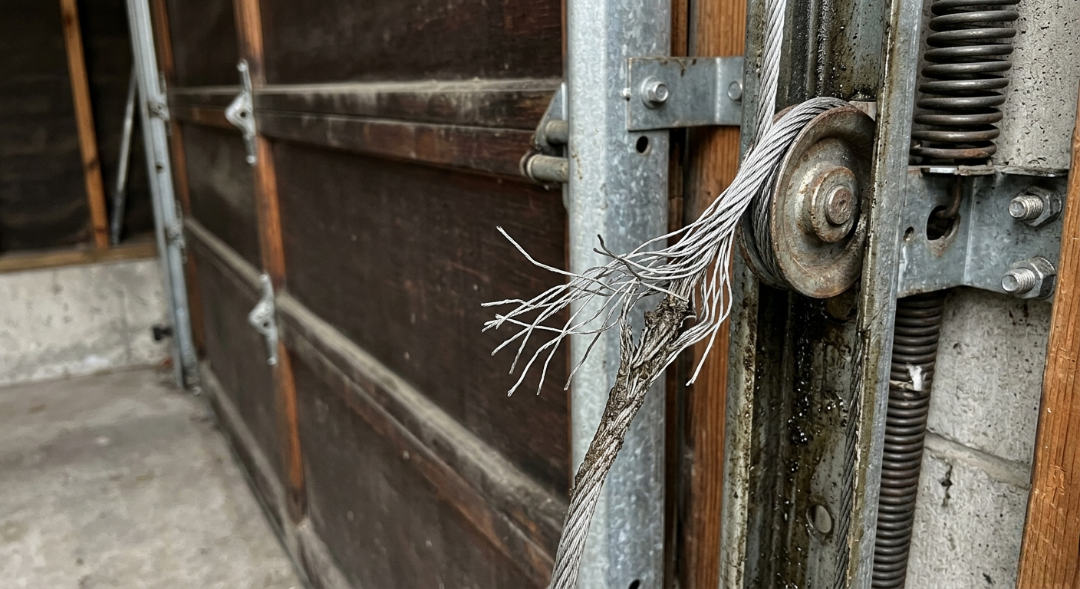
- Heavy Grinding or Popping: A strong indicator that the solid-steel torsion shaft is shifting, or the heavy-duty lifting cables are beginning to fray and slip against the aluminum cable drums.
Critical Safety Warning: Frayed cables are an absolute emergency. Under the immense weight loads of a commercial system, a snapping cable can cause the door to drop instantly like a guillotine, presenting a severe risk of life-threatening workplace injury. Workplace safety standards outlined by the Occupational Safety and Health Administration (OSHA) require immediate lockout tagout procedures for any industrial machinery demonstrating compromised structural cables or springs.
4. Failing Climate Control Boundaries and Perimeter Gaps
Chicago warehouse operators face brutal, distinct weather extremes, from freezing winter blizzards off Lake Michigan to scorching, humid summer waves. Maintaining precise ambient temperatures inside your facility is critical for protecting temperature-sensitive inventory and managing corporate utility bills.
If you can see clear daylight peeking through the edges or underneath the bottom section of your dock doors when they are fully shut, your perimeter sealing has failed. Over time, heavy cycles flatten out the heavy-duty rubber loop astragal bottom seals and tear away the brush or vinyl jamb weather-stripping.
Beyond letting expensive heated or cooled air escape into the atmosphere, these structural gaps create an open invitation for water runoff, driving snow melt, and destructive rodent infestations. To review federal industrial energy consumption metrics and thermal building envelope benchmarks, commercial property managers can reference data models hosted by the U.S. Department of Energy.
5. Chronic Torsion Spring Fatigue and Cable Slack
The brute force required to elevate a heavy-gauge, insulated commercial steel door comes directly from massive industrial torsion springs mounted on a solid steel shaft above the header. These high-cycle springs are rated for specific lifespans, usually ranging from 25,000 to 100,000 operational cycles.
As a spring nears the end of its operational life cycle, the tempered steel loses its elastic memory and begins to unwind slightly. This fatigue manifests as subtle slack or looping in the heavy-duty aircraft cables wound around the side drums. If you notice your cables look loose when the door is fully raised, or if the door panels consistently drift down a few inches after opening completely, the springs have lost their structural tension.
Left unaddressed, the steel will reach its absolute yield limit and snap with an explosion of force, immediately locking down your loading bay and halting warehouse operations.
Protect Your Logistics Flow with Professional Commercial Repair
Attempting a DIY fix on an industrial overhead door is an extreme liability that threatens employee safety and structural equipment. Commercial systems operate with immense mechanical forces that require specialized heavy-duty tools, certified replacement components, and advanced rigging knowledge to service correctly. Working with a dedicated commercial specialist ensures that your loading docks meet strict building codes, maintain maximum operational uptime, and keep your daily logistics moving safely and predictably.
Secure Your Loading Dock Infrastructure with EK Garage Door
Don’t let a malfunctioning commercial door disrupt your supply chain or compromise your facility’s safety standards. The commercial team at EK Garage Door provides rapid, industrial-grade diagnostic evaluations, emergency tracking repairs, and high-cycle spring replacements tailored specifically for Chicago warehouse layouts. Our factory-certified technicians arrive equipped with commercial-spec hardware to execute robust, reliable repairs with minimal downtime to your operation. Head over to our EK Garage Door Services Page or get in touch with our commercial dispatch office today to schedule your safety inspection and keep your facility running at peak performance.