

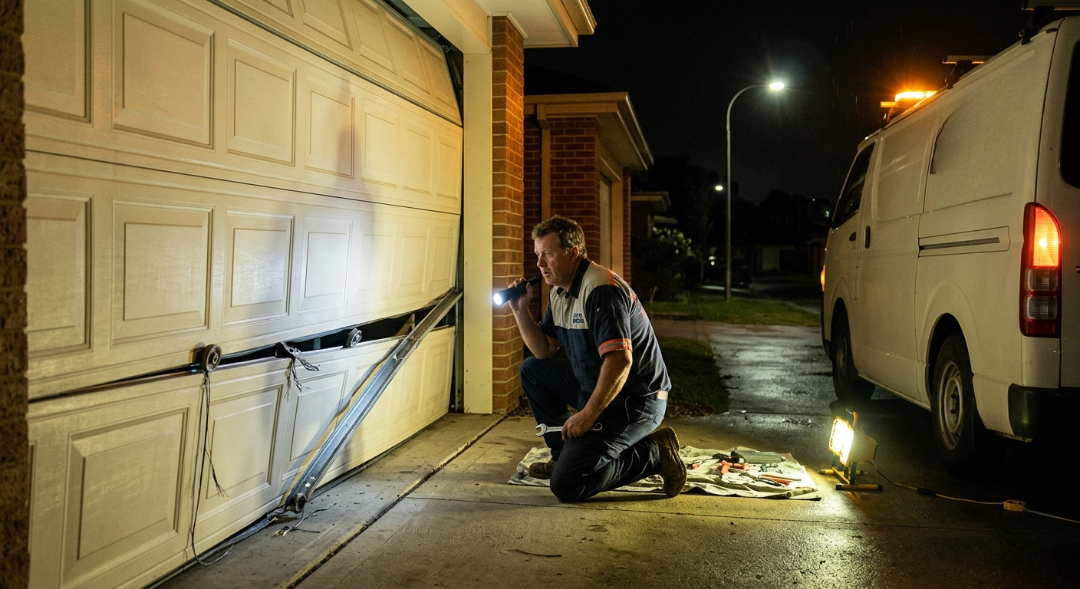
There are few residential mishaps more stressful than rushing out the door for your morning commute, pressing your garage door remote, and hearing nothing but a hollow click or a straining motor. Whether you are heading to an important meeting downtown, trying to beat rush-hour traffic on the Kennedy Expressway, or rushing to catch a flight at O’Hare, a trapped car turns a normal day into an immediate household emergency.
When a garage door mechanical failure traps your vehicle inside, it can be tempting to use raw physical force to solve the problem. However, because garage doors operate under extreme mechanical tension, hasty actions can result in devastating injuries, permanent property damage, or a completely ruined automated opener. Knowing exactly how to assess the situation safely, override the system manually, and when to call in professional reinforcements is the key to resolving a garage door crisis without making a stressful situation much worse.
Why Is Your Car Trapped? Identifying the Root Cause
Before attempting to move the door, it helps to understand why it refuses to open. Identifying the root cause of the failure can prevent you from causing secondary, more expensive damage to the door’s tracking and motor systems.
1. A Broken Torsion or Extension Spring
The most common culprit behind a suddenly immobilized garage door is a snapped spring. Many homeowners believe the electric opener does the heavy lifting, but the springs actually counterbalance the massive weight of the door. When a spring snaps, often accompanied by a loud, gunshot-like bang, the door instantly becomes dead weight, weighing anywhere from 150 to over 400 pounds. Attempting to lift a door with a broken spring manually is incredibly difficult and highly dangerous.
2. Snapped or Slipped Cables
Garage door cables work in tandem with the springs to pull the door upward. If a cable frays and snaps, or if it slips off its designated drum assembly, the door will lose its lifting tension entirely. This often causes the door to hang at a dangerous, crooked angle within the vertical tracks, completely jamming the rollers.
3. Misaligned or Obstructed Photo-Eye Sensors
If your garage door opener clicks and the light bulb flashes but the door refuses to budge or moves down an inch and reverses, your safety photo-eyes are likely compromised. These small infrared sensors sit a few inches off the ground on both sides of the door track. If they are bumped out of alignment, covered in Chicago winter road salt grime, or blocked by a rogue garbage can, they signal the system that an object is in the path, locking down automated operation.
Step-by-Step Guide: How to Safely Override the System

If your vehicle is stuck inside and the tracking system appears straight and undamaged, you can attempt to manually open the door using the safety release mechanism. Follow these safety protocols precisely to avoid dropping the door onto your vehicle or yourself.
Step 1: Ensure the Door is Fully Closed
Never pull the emergency release cord if the garage door is partially open. If a spring or cable is broken, the only thing keeping that heavy door suspended is the electric opener carriage. Pulling the release cord while the door is open will cause it to crash down violently like a guillotine, instantly crushing anything underneath it and presenting a severe hazard as tracked by the U.S. Consumer Product Safety Commission (CPSC).
Step 2: Pull the Red Emergency Release Cord
Locate the red cord with a plastic handle hanging down from the automated opener’s trolley track. Pull this handle straight down and back toward the motorized unit. This action disengages the internal locking pin connecting the door arm to the automated chain or belt drive, placing the garage door into manual mode.
Step 3: Attempt a Controlled Manual Lift
Stand in the center of the door, bend your knees, and lift using the designated handles on the interior panels. If the springs are intact, the door should slide upward with relatively little effort. Lift it all the way to the top of the tracks until it stops.
Step 4: Secure the Door Before Moving Your Car
Do not assume the door will stay open on its own. If the tracking system is worn or if a spring is starting to fail, gravity can pull it back down unexpectedly. Before backing your car out of the garage, secure the door in the fully open position. You can clamp a pair of locking pliers (Vise-Grip) onto the metal track directly beneath one of the rollers to mechanically block the door from sliding downward. Once secured, carefully back your vehicle out into the driveway.
What Not to Do During a Garage Door Emergency
When time is running out, panic can cloud your judgment. Avoid these dangerous mistakes at all costs:
- Do Not Use Your Car to Force the Door Open: It may sound obvious, but some homeowners attempt to nudge a stuck door open with their vehicle’s bumper. Modern garage doors and car bumpers are not built to withstand this kind of blunt force; you will end up with thousands of dollars in vehicular body damage and a completely destroyed garage door structural frame.
- Do Not Keep Pressing the Remote Button: If the door is jammed or a spring is broken, repeatedly pressing the wall button will simply burn out the electric motor’s internal capacitors or completely strip the main drive gear inside the housing.
- Do Not Attempt DIY Spring Adjustments: Torsion springs hold enough kinetic energy to snap like a whip, causing severe lacerations or fractures. For safety guidelines regarding complex residential machinery and high-tension components, consult engineering standards managed by organizations like the National Institute of Standards and Technology (NIST).
Preventative Measures to Avoid Future Lockouts
The best way to manage a garage door emergency is to prevent it from happening in the first place through routine structural care.
First, perform a monthly balance check. Put the door in manual mode and lift it halfway up; a perfectly balanced door will stay suspended in place. If it falls or shoots upward, the spring tension is incorrect and needs immediate professional calibration. Second, keep the mechanical hardware thoroughly lubricated. Applying a high-quality silicone or lithium-based spray to the rollers, hinges, and springs twice a year reduces friction and prevents early metal fatigue. Finally, schedule a comprehensive annual maintenance tune-up with a certified technician to catch fraying cables and weakening springs before they completely fail.
24/7 Emergency Garage Door Repair in Chicago
When your car is trapped and your schedule is on the line, you don’t have time to wait days for a standard repair appointment. The professional team at EK Garage Door understands that a broken garage door is a security risk and an immediate logistical nightmare. Our certified, highly experienced technicians are fully equipped with specialized tools and heavy-duty replacement springs and cables to handle any residential emergency safely and efficiently. We provide rapid, reliable emergency dispatch across the entire Chicago metropolitan area to get your door operational and your vehicle freed in record time. Do not compromise your safety by battling a heavy, malfunctioning door alone, contact us today for immediate, expert assistance.