

In the world of home maintenance, there is a clear line between tasks that are suitable for a weekend enthusiast and those that carry significant physical risk. While painting a wall or replacing a faucet is a manageable DIY project, garage door spring adjustment occupies a category of its own. At EK Garage Door, we have witnessed the aftermath of well-intentioned homeowners attempting to “tighten” or “balance” their own springs. The results often range from damaged property to severe personal injury.
Understanding the mechanics of a garage door system is essential for recognizing the hidden dangers within. Your garage door is likely the largest and heaviest moving object in your home, and the springs are the components that hold the literal weight of that system in a state of extreme tension.
The Physics of Tension: Why Springs Are Dangerous
To understand why a spring adjustment is so hazardous, one must understand the physics at play. A standard double-car garage door can weigh anywhere from 150 to over 400 pounds. The electric opener is not actually responsible for lifting this weight; rather, it simply guides the door. The heavy lifting is performed by the torsion or extension springs.
When a torsion spring is wound, it stores a massive amount of potential energy. This energy is what allows a person, or a small motor, to lift a heavy steel door with ease. However, that stored energy is also what makes the spring a “loaded weapon.” If a spring snaps or a winding bar slips during an adjustment, that energy is released instantaneously. According to safety reports from the U.S. Consumer Product Safety Commission (CPSC), garage door-related incidents account for thousands of emergency room visits annually, with a significant portion involving spring-related failures.
Common Signs Your Springs Need Adjustment
Before discussing the “how” of professional repair, it is important to identify the “when.” A garage door that is out of balance puts immense strain on the opener, the cables, and the rollers. If you notice any of the following symptoms, your springs likely require professional calibration:
- The Door Feels Heavy: If you disconnect the opener and try to lift the door manually, it should stay in place when halfway open. If it slams shut, the springs have lost their tension.
- Irregular Movement: A door that rises or falls unevenly or “stutters” during operation often has uneven tension across the two springs.
- Excessive Noise: Loud squeaking, groaning, or a sudden “bang” (indicating a snap) are clear indicators of spring fatigue.
- Slow Operation: If your motor is struggling more than usual to open the door, it is likely compensating for weak springs.
The Complexity of Torsion vs. Extension Systems
There are two primary types of spring systems used in Chicago homes, and each requires a specific set of tools and technical knowledge. Torsion springs are mounted on a metal rod above the door opening. Adjusting these requires specialized winding bars and a deep understanding of how many “quarter-turns” are necessary to achieve balance without over-stressing the metal.
Extension springs, found on the sides of the door tracks, act like giant rubber bands. While they may appear less intimidating, they are equally dangerous. If an extension spring breaks without a safety cable installed through its center, it can become a high-velocity projectile capable of piercing through drywall or car windows. Professionals ensure that all safety redundancies are in place before any adjustment begins.
The Professional Advantage: Expertise and Specialized Tools

At EK Garage Door, our commitment to E-E-A-T (Experience, Expertise, Authoritativeness, and Trustworthiness) is demonstrated through our rigorous safety protocols. A professional technician brings more than just a wrench to the job; they bring years of localized experience dealing with the specific challenges of the Chicago climate.
Specialized Tooling
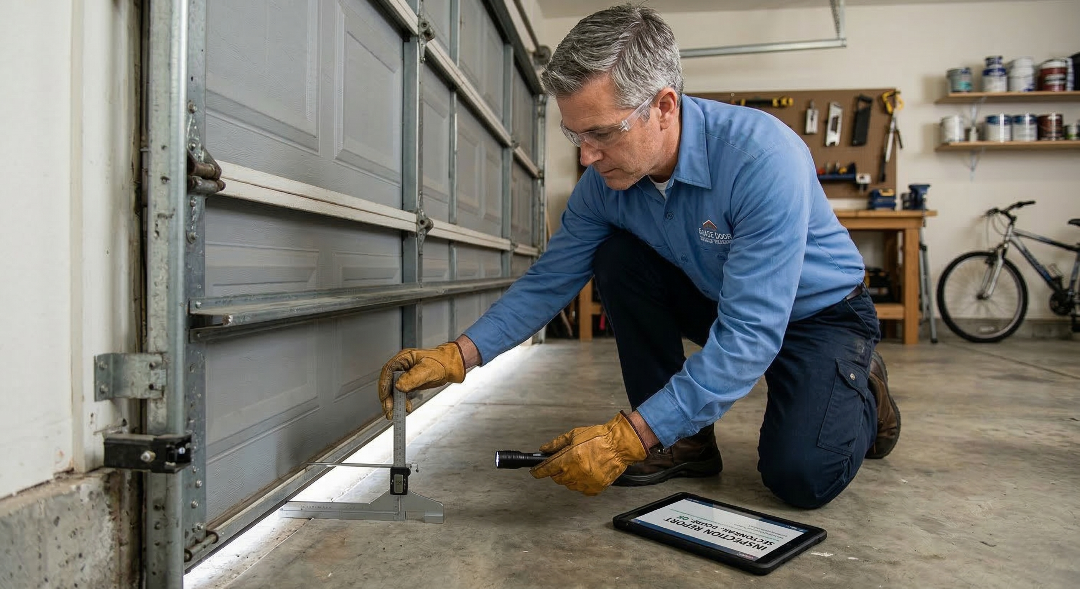
Professionals use non-slip winding bars specifically designed for the diameter of the spring’s winding cone. Homeowners often attempt to use screwdrivers or pliers, which are prone to slipping and causing the spring to unwind uncontrollably. We also utilize high-precision scales to measure the exact weight of the door, allowing us to calculate the precise torque required for a perfect balance.
Identifying Secondary Issues
A spring adjustment is rarely an isolated event. When our technicians evaluate a system, we look for frayed cables, worn bearings, and cracked rollers. Often, a homeowner thinks a spring needs tightening when, in reality, a bearing has seized. Adjusting the spring in this scenario would only mask a deeper problem that could lead to a total system collapse later.
Climate-Specific Calibration
Chicago’s extreme temperature fluctuations, from sub-zero winters to humid summers, cause metal to expand and contract. This environmental stress can lead to “metal fatigue.” Professionals understand how to calibrate springs to account for these shifts, ensuring the door operates smoothly regardless of the season. Information on the structural integrity of metals under stress can be further explored through materials science resources such as those provided by the National Institute of Standards and Technology (NIST).
The Financial Risk of DIY “Savings”
Many homeowners attempt DIY spring adjustments to save on service fees. However, the financial risk of a mistake far outweighs the cost of a professional call. If a spring is over-tightened, it can snap prematurely or cause the opener’s internal gears to strip. If the door falls due to an improper adjustment, the cost of replacing the entire door and the opener will be thousands of dollars more than a simple maintenance visit.
Furthermore, most garage door manufacturers void the warranty if the system is tampered with by an unlicensed individual. By hiring a professional, you protect your investment and ensure that any manufacturer warranties remain intact.
Prioritizing Household Safety
Beyond the risk to the person performing the work, an improperly adjusted door is a threat to everyone who uses the garage. A door that is not perfectly balanced can close with enough force to bypass the safety sensors’ auto-reverse function. This creates a significant entrapment hazard for children and pets. When a certified technician from EK Garage Door finishes a job, we perform a 25-point safety inspection to ensure that the “close-force” and “reversal” settings are functioning exactly as intended.
Trust EK Garage Door for Your Safety and Peace of Mind
Your safety is our primary concern. A garage door spring is a marvel of mechanical engineering, but it demands respect and professional handling. At EK Garage Door, we provide the expertise needed to keep your door running smoothly, quietly, and, most importantly, safely. Don’t risk a life-altering injury or a costly property repair by attempting to handle high-tension springs on your own. Contact us today to schedule a professional spring inspection and adjustment to ensure your home remains a safe and secure environment.