

A garage door that has slipped from its tracks is more than a mechanical failure; it is a significant safety hazard that leaves your home vulnerable and your vehicle trapped. In the bustling neighborhoods of Chicago, a garage door is a primary entry point, and when it sits crooked or jammed, it presents an immediate crisis. At EK Garage Door, we have seen the damage that occurs when homeowners attempt to force a door back into place. This guide explains the mechanics of a door that has gone off-track, the immediate safety steps you must take, and how to identify when a professional intervention is the only safe path forward.
Understanding why a door leaves its tracks is the first step in prevention. Whether caused by a broken cable, a minor vehicular impact, or simple mechanical fatigue, an off-track door is under immense, uneven tension that can lead to a catastrophic collapse if handled incorrectly.
Why Garage Doors Slip Off Their Tracks
Several factors can lead to a garage door becoming unseated. Identifying the root cause is essential for a permanent fix, as simply popping the rollers back in will not solve the underlying structural instability.
Physical Impact and Obstructions One of the most common causes is a “fender bender” or hitting the door with a trash bin. Even a slight dent in a lower panel can shift the vertical alignment, causing the rollers to jump the track during the next operation cycle. Similarly, if an object, like a broom handle or a piece of sports equipment, gets caught in the track while the door is moving, the motor may continue to pull, forcing the rollers out of their designated path.
Broken Torsion Cables Garage doors rely on high-tension cables to lift and lower the heavy sections evenly. If one of these cables snaps or becomes frayed, the door will lose its balance instantly. The side with the functioning cable will continue to lift, while the other side drops, causing the door to sit at a dangerous angle. According to safety standards outlined by the Consumer Product Safety Commission (CPSC), cable and spring failures are leading causes of overhead door accidents.
Worn Rollers and Loose Hardware Over time, the rollers that guide your door can wear down or lose their lubrication, leading to increased friction. If a roller seizes, it can skid across the track instead of rolling, eventually popping out of the guide. Furthermore, Chicago’s extreme temperature fluctuations cause the metal tracks to expand and contract. This movement can loosen the mounting bolts that secure the tracks to the garage walls, leading to a “widening” of the tracks that allows the door to slip through.
Immediate Safety Protocol: What to Do First
If you look up and see your garage door hanging precariously by a single roller or sitting at an awkward tilt, stop all operation immediately.
Do Not Use the Electric Opener The most dangerous thing you can do is attempt to “power through” the problem using your remote. Modern openers are powerful; if the door is jammed and you trigger the motor, you risk burning out the gear kit, snapping the remaining cables, or pulling the entire track system off the ceiling. This can result in the door falling flat, potentially causing life-threatening injuries or crushing your vehicle.
Disengage the Motor Safely If the door is in the fully closed position, you can pull the red emergency release cord to disconnect it from the opener. However, never pull the release cord if the door is open or partially open. Without the motor’s carriage holding it in place, an off-track door may have nothing supporting its weight. If the springs are damaged, the door will fall like a guillotine the moment the release is pulled.
The Technical Reality of Repairing an Off-Track Door
At EK Garage Door, we approach an off-track situation with a focus on E-E-A-T (Experience, Expertise, Authoritativeness, and Trustworthiness). Repairing a door involves more than just physical strength; it requires a deep understanding of counterbalance physics.
Assessing Track Alignment and Verticality
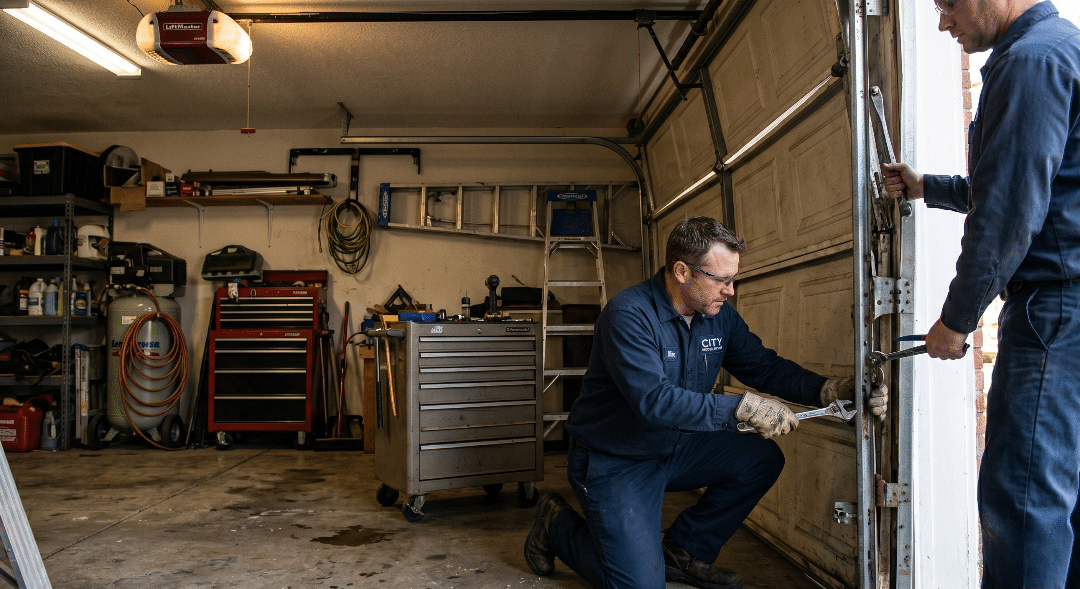
Our technicians use precision levels to ensure the tracks are perfectly plumb. We don’t just put the rollers back; we inspect the tracks for “gapping.” If the tracks have moved, we must re-anchor them into the wall studs using heavy-duty lag bolts. For homes in Chicago, we often see tracks that have shifted due to the settling of older foundations or the vibration of nearby transit lines.
Cable Tension and Spring Calibration
Before a door can be re-tracked, the tension must be neutralized. We use specialized winding bars to safely manage the torsion springs, allowing us to reset the cables on their drums. Attempting to fix a cable without the proper tools is incredibly dangerous. These cables are under hundreds of pounds of pressure; if they slip, they can cause severe lacerations. You can learn more about the engineering of tensioned systems through resources at the National Institute of Standards and Technology (NIST).
Why This Is Rarely a DIY Project
While many home repairs are satisfying to complete yourself, an off-track garage door is one of the few instances where professional help is a necessity rather than a luxury. The primary reason is the risk of a total system collapse. When a door is off its track, its center of gravity has shifted. A single wrong move can cause the remaining rollers to fail, dropping the entire door.
Furthermore, a professional repair includes a comprehensive safety check. We inspect the “end bearings,” the “center bracket,” and the “rollers” to ensure that the reason the door went off-track is fully addressed. If you simply pop a door back onto a bent track, it will likely fail again within days, often with more violent results the second time around.
Preventive Maintenance: Keeping the Rollers in Line
Once your door is restored, maintaining it is the best way to prevent a recurrence. We recommend a “Search and Tighten” routine twice a year. Use a wrench to ensure the bolts holding the tracks to the wall are snug. Additionally, keep the tracks clean. Use a damp cloth to wipe away grease and road salt, which can cause the rollers to slip.
Lubrication is also key. Using a silicone-based or lithium-based spray on the rollers (but not inside the tracks themselves) ensures a smooth glide. Proper lubrication reduces the friction that leads to rollers jumping their guides.
Restore Your Home’s Security with EK Garage Door
A garage door that is off its tracks is a major disruption to your safety and your schedule. At EK Garage Door, we provide rapid-response, expert repairs designed to get your door back in alignment safely and efficiently. We understand the stress of a jammed door, and our Chicago-based technicians are equipped with the industrial tools and experience necessary to handle even the most complex mechanical failures. Don’t risk your safety or your property by trying to force a heavy overhead door back into place. Contact us today to schedule an emergency service call; we will ensure your door is properly balanced, securely tracked, and safe for your family to use.