


Discovering that your garage door refuses to close is more than just a minor inconvenience; it is a significant security risk and a safety hazard for your household. In a city like Chicago, an open garage door also means exposing your home to the unpredictable Midwestern elements and potentially skyrocketing your energy bills. At EK Garage Door, we have spent years diagnosing and resolving overhead door failures. This guide is designed to help you navigate the immediate steps to take, the safety protocols to follow, and how to identify when a simple fix has turned into a professional repair job.
Understanding the mechanics of your door is the first step toward a resolution. A garage door is a complex system of counterbalanced weights, sensitive electronics, and high-tension springs. When the system detects an abnormality, its default safety response is to remain open or reverse immediately.
Immediate Troubleshooting: The Photo-Eye Sensors
The most common reason a garage door won’t close, accounting for nearly 70% of service calls, relates to the electronic safety sensors, or “photo-eyes.” These small sensors are located near the floor on both sides of the door track. They project an invisible infrared beam across the opening; if that beam is broken, the door will not close as a primary safety measure.
Checking for Obstructions and Alignment The first thing you should do is ensure the path is completely clear. Sometimes a stray leaf, a child’s toy, or even a build-up of Chicago road salt can block the lens. If the path is clear, look at the LED lights on the sensors themselves. Usually, one is green and one is amber. If they are blinking or off, the sensors are misaligned. You can gently nudge them back into place until the lights glow steadily.
Cleaning the Lenses Because these sensors sit close to the ground, they are prone to getting dirty. Use a soft, dry cloth to wipe away dust or spiderwebs. Avoid using harsh chemicals that could cloud the plastic lens. Ensuring these sensors are functional is not just about convenience; it is a federal safety requirement. According to the Consumer Product Safety Commission (CPSC), all garage door openers manufactured after 1993 must include these entrapment protection features to prevent injuries.
Investigating Mechanical Obstructions and Track Issues
If the sensors are aligned and clear but the door still stops midway through its descent, the problem may be physical. A garage door travels along a set of tracks that must be perfectly parallel and free of debris to function.
Inspecting the Tracks and Rollers Over time, the vibration of the door can cause the mounting bolts on the tracks to loosen, leading to misalignment. If the track is even slightly bent or shifted, the rollers will bind, causing the motor to “sense” an obstruction and reverse. Visually inspect the length of the track for any pebbles, dried grease, or small objects that might be caught.
The Dangers of DIY Track Adjustment While it might be tempting to use a hammer to straighten a bent track, this often worsens the problem. The tracks are precision-aligned to support the weight of the door. An improper adjustment can cause the door to fall out of the tracks entirely, which is a catastrophic failure. If you notice significant bending or if the rollers are “popping” out of the track, it is time to call a professional.
Addressing Limits and Travel Settings
Your garage door opener has internal “limit settings” that tell the motor exactly how far to travel before it reaches the floor. If these settings are disrupted, often due to a power surge or a recent battery replacement, the door may hit the floor and immediately bounce back up, thinking it has hit an object.
Adjusting the Close Limit Most modern openers have adjustment screws or digital buttons on the motor head. These allow you to fine-tune the “travel” of the door. If the door reverses after touching the ground, the limit is likely set too low. However, adjusting these requires precision; if you set the force too high, the door will continue to push against the floor, which can damage the motor’s gear kit or the door’s bottom seal.
When the Problem is the Springs or Cables
If you hear a loud “bang” and the door refuses to move, or if the door appears lopsided as it tries to close, you are likely dealing with a broken torsion spring or a snapped cable. This is the most dangerous scenario for any homeowner.
Why Springs Are Critical The springs do the heavy lifting, not the motor. When a spring breaks, the motor is suddenly trying to move several hundred pounds of dead weight. You should never attempt to close the door manually if you suspect a broken spring. The tension held within these components is immense and can cause life-threatening injuries if handled without specialized tools.
For more information on the physical forces involved in overhead systems, you can refer to mechanical safety engineering resources provided by Occupational Safety and Health Administration (OSHA) regarding heavy machinery and tensioned systems.
Safety First: Using the Manual Release
If your door is stuck open and you need to secure your home before a technician arrives, you may need to use the manual release cord, usually a red rope hanging from the opener carriage.
The Proper Way to Pull the Cord Only pull the manual release when the door is in the fully closed position if possible. If the door is stuck open, be extremely cautious. If a spring is broken, pulling that card will cause the door to crash down with full force. At EK Garage Door, we always recommend having a second person assist you in slowly guiding the door down by hand once the motor is disengaged, ensuring no feet or fingers are near the bottom edge.
Why Professional Diagnosis Matters
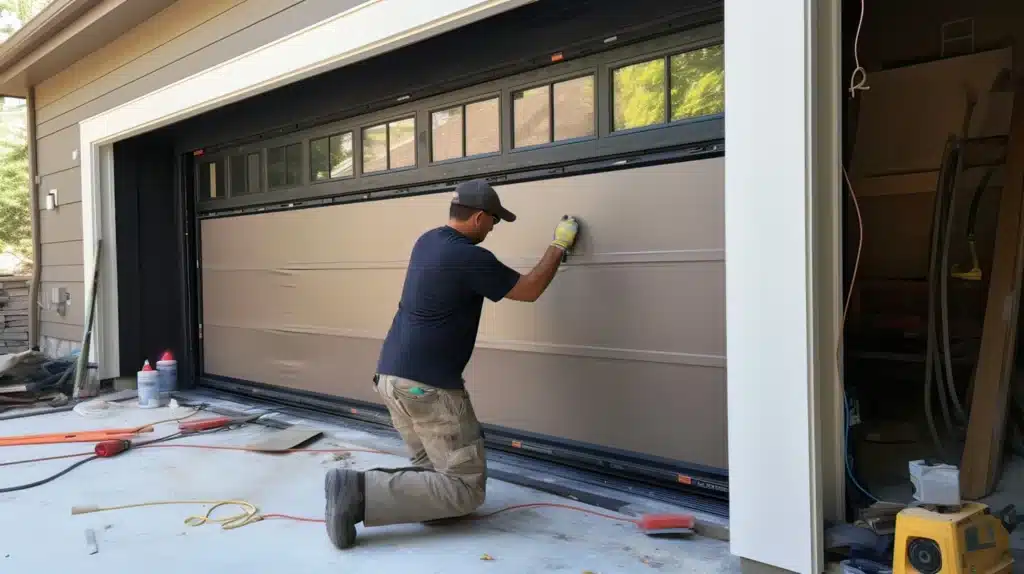
At EK Garage Door, we pride ourselves on Experience, Expertise, Authoritativeness, and Trustworthiness (E-E-A-T). While DIY tips are helpful for minor sensor alignment, a garage door that won’t close often points to an underlying structural issue. Our technicians use specialized diagnostic tools to check the “balance” of the door. A perfectly balanced door should stay in place when left halfway open; if it falls or shoots up, the spring tension is incorrect, which will eventually burn out your opener.
We understand the Chicago landscape, from the humidity that swells wooden doors to the sub-zero temperatures that thicken garage door lubricant. We don’t just fix the symptom; we ensure the entire system is optimized for the local environment.
Secure Your Home with EK Garage Door
Leaving your garage door open is an invitation to unwanted guests and a drain on your home’s efficiency. If you have tried the basic troubleshooting steps and your door still refuses to close, do not risk your safety by forcing the mechanism. Our team of certified experts is ready to provide rapid, reliable, and transparent repair services to get your life back on track. We offer comprehensive inspections to ensure that once your door is closed, it stays that way. Contact us today to schedule an emergency repair and restore the security of your Chicago home.