

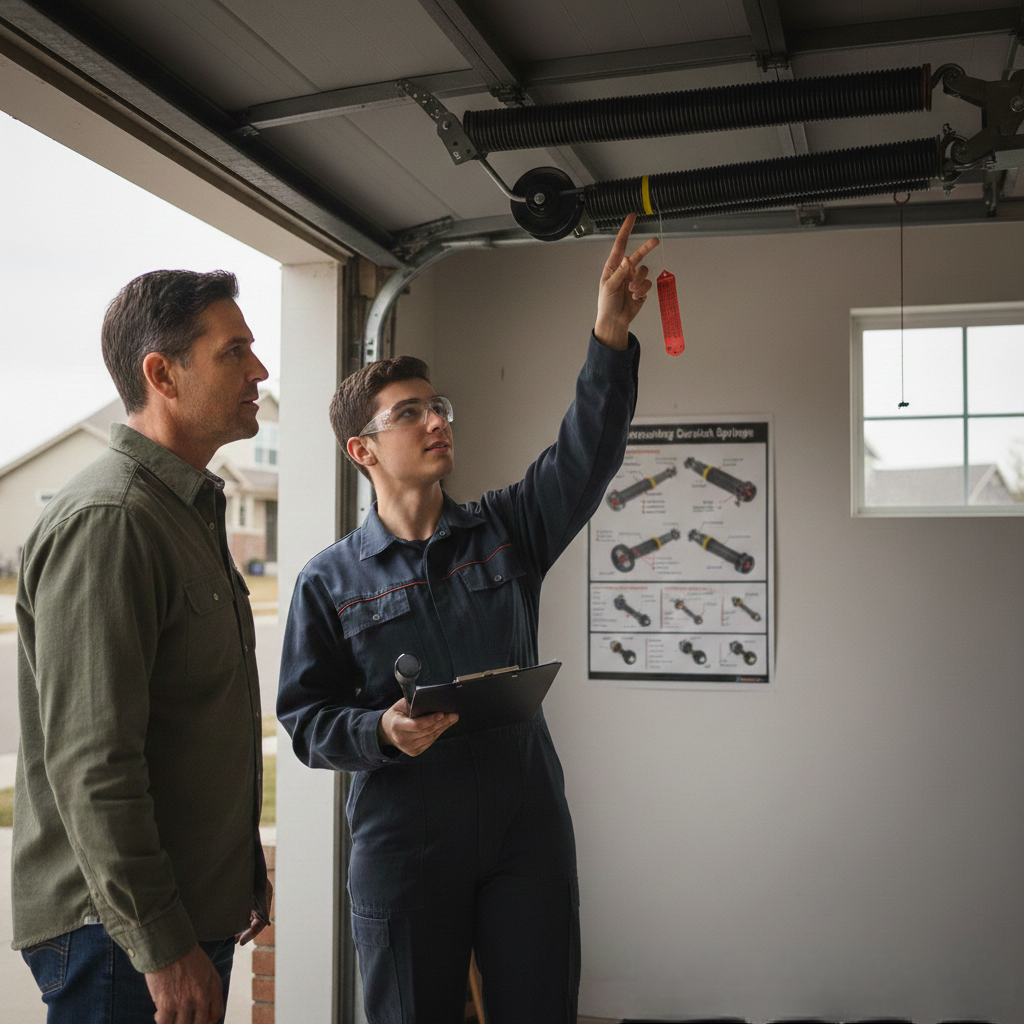
A Comprehensive Guide to Understanding Garage Door Springs
For many Chicago homeowners, the garage door is the most used entry point to the home. We press a button, and the door glides upward effortlessly. However, that “effortless” movement isn’t powered by the motor alone; the real heavy lifting is done by the garage door springs. These high-tension components counterbalance the hundreds of pounds of steel and insulation, making the door light enough to be moved by a small motor or a human hand. At E.K. Garage Door, we believe that understanding the mechanics and safety risks of your springs is essential for every homeowner.
The Engineering of Counterbalance: How Springs Work
A standard residential garage door can weigh anywhere from 150 to over 400 pounds. Without a counterbalancing system, opening such a door would require immense physical strength and would likely burn out a standard opener motor in a single use. Garage door springs solve this by storing energy when the door is closed.
When the door is in the “down” position, the springs are under maximum tension, either stretched out or wound tightly. As you initiate the opening cycle, this stored potential energy is released, providing the torque or pull necessary to neutralize the door’s weight. According to engineering principles detailed by the University of Nebraska-Lincoln, the spring acts as a mechanical battery, discharging its energy to assist the lift and recharging as gravity pulls the door back down to the floor.
Torsion vs. Extension Springs: What’s in Your Garage?
Most Chicago residences utilize one of two primary spring systems. Identifying which one you have is the first step in proper maintenance.
Torsion Springs: The Modern Standard
Torsion springs are the large, tightly wound coils located on a metal shaft directly above the garage door opening. They operate by twisting (torsion) rather than stretching. When the door closes, cables attached to the bottom corners pull on drums, which in turn wind the springs.
- Longevity: Torsion springs typically last 10,000 to 20,000 cycles.
- Safety: Because they are mounted on a shaft, if they snap, they generally stay on the bar rather than flying across the garage.
- Smoothness: They provide a more balanced, steady motion, which is ideal for heavy, insulated doors.
Extension Springs: The Legacy Choice
Commonly found in older Chicago bungalows or garages with low headroom, extension springs run horizontally along the upper tracks on both sides of the door. They operate by physically stretching out as the door closes.
- Cost: These are often less expensive to install initially.
- Risk Factor: Because they are not secured on a shaft, they require safety cables to prevent them from becoming dangerous projectiles if they snap under tension.
- Wear Pattern: They often wear unevenly, which can cause the door to become “jerky” or lopsided over time.
Why Garage Door Springs Are Inherently Dangerous
The tension required to lift a 300-pound door is immense. If a spring fails, that energy is released instantly and violently. This is why the U.S. Consumer Product Safety Commission (CPSC) classifies garage door springs as high-risk components. A snapping spring can shatter windows, dent car hoods, or cause life-threatening injuries to anyone standing nearby.
Beyond the risk of a sudden break, the act of adjusting or replacing these springs is where most DIY accidents occur. Torsion springs require specialized winding bars and precise torque calculations. One slip of a wrench can result in the high-speed unwinding of the steel coil, which can easily break bones or cause severe lacerations. At E.K. Garage Door, we strongly advise homeowners to stick to visual inspections and leave the mechanical work to certified technicians.
Identifying the Warning Signs of Spring Fatigue
Springs do not last forever. Most are rated for a specific number of “cycles” (one opening and one closing). For a family that uses the garage four times a day, a 10,000-cycle spring will likely reach its elastic limit in about 6 to 7 years.
Watch for these red flags in your garage:
- The “Loud Bang”: If you hear a thunderous noise from the garage while no one is there, it is likely a torsion spring snapping.
- Visible Gaps: A broken torsion spring will show a clear separation of two or more inches between the coils.
- The Heavy Door Test: If your opener struggles to lift the door or if the door feels impossible to lift manually, the springs have likely lost their tension.
- Lopsided Movement: If one side of the door hangs lower than the other, an extension spring on one side has likely failed or stretched.
- Slow Response: If the door starts to open but stops after a few inches, the opener’s safety sensors are detecting that the “dead weight” is too heavy to lift safely.
Extending the Life of Your Springs
While you shouldn’t adjust springs yourself, you can significantly extend their lifespan with basic care. Chicago’s humidity and road salt are the primary enemies of spring steel, leading to rust that creates “friction points” within the coils.
We recommend applying a high-quality silicone-based lubricant to the springs every three to six months. This prevents rust and allows the coils to slide against each other smoothly, reducing the internal heat and friction that leads to metal fatigue. Additionally, keeping your garage well-ventilated and your bottom weatherstripping intact can reduce the moisture levels that accelerate corrosion. For more technical guidance on residential mechanical standards, the International Code Council (ICC) provides extensive benchmarks for property maintenance.
Professional Care for Chicago Homeowners
At E.K. Garage Door, we specialize in the high-precision world of garage door spring replacement and calibration. We understand that a broken spring isn’t just a mechanical failure; it’s a disruption that can trap your car in the garage or leave your home vulnerable. Our technicians carry a wide variety of high-cycle springs on our trucks, ensuring that we can provide a safe, “one-trip” solution to get your door back in balance. We perform a full safety inspection with every spring service, checking your cables, drums, and bearings to ensure the entire system is working in harmony. Don’t risk your safety or the integrity of your home on a DIY spring repair. Call us today at (312) 860-1171 to schedule a professional balance test and inspection.