

Few things disrupt a Chicago morning faster than a stuck garage door. Whether you are rushing to beat rush hour on the Kennedy or simply trying to get the kids to school, a door that refuses to open or close turns a routine exit into a frustrating, and sometimes costly, ordeal.
Most stuck garage doors are not random failures. They are the predictable result of wear, seasonal stress, or a small mechanical issue that grew worse over time. Below, we break down the 10 most common causes of a stuck garage door so you can identify the problem, understand what is safe to check yourself, and know exactly when to call a professional.
1. Broken or Worn-Out Torsion Springs
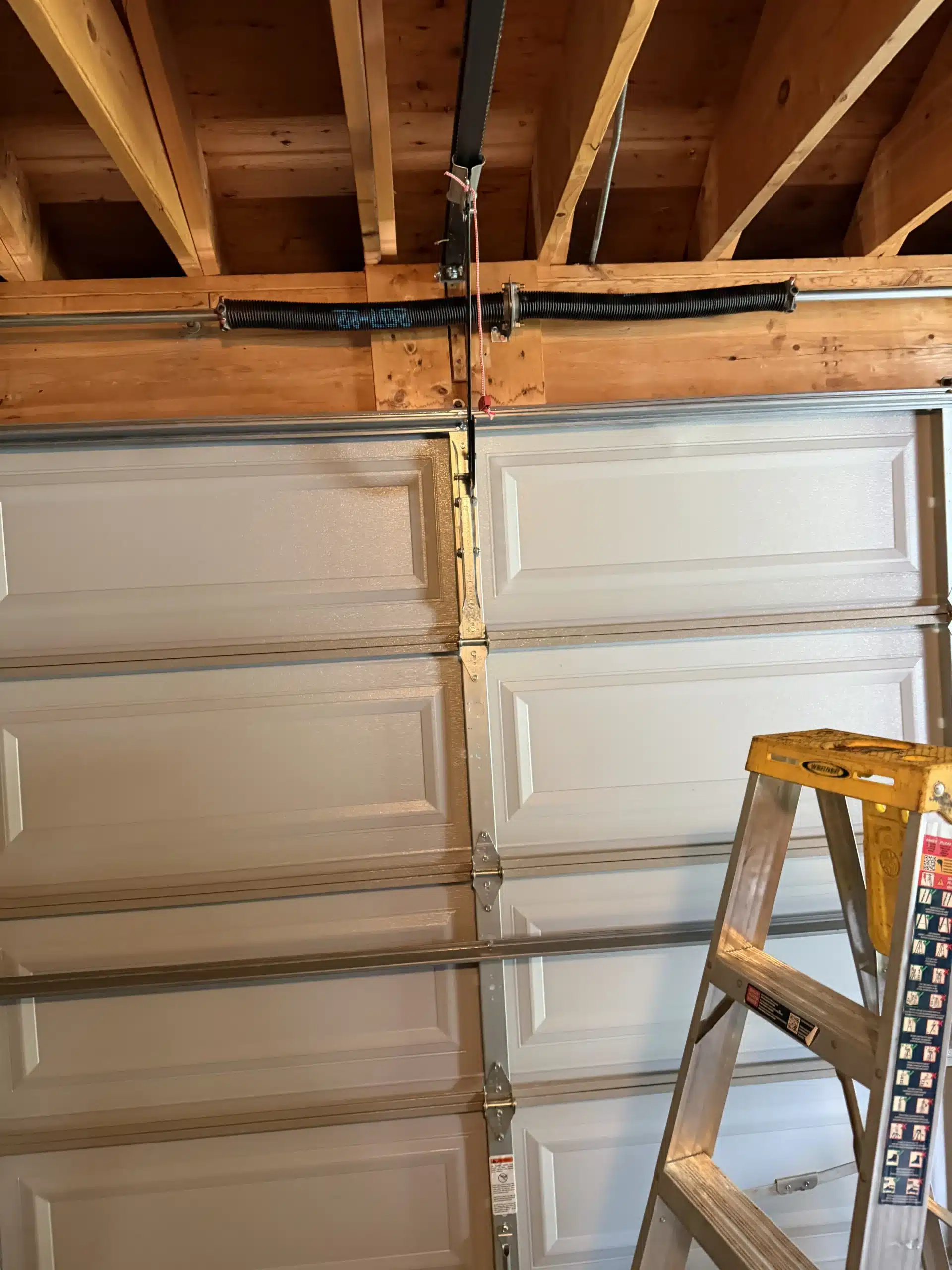
Torsion springs mounted above the door counterbalance hundreds of pounds of weight. When a spring snaps or gradually loses tension, the opener motor is left trying to lift a load it was never designed to carry alone, and the door simply will not move.
A telltale sign is a loud bang from the garage followed by a door that feels unusually heavy when lifted by hand. A visible gap in the spring’s coils confirms the break.
2. Misaligned or Dirty Safety Sensors
Federal law requires every residential opener to include photo-eye safety sensors near the bottom of the tracks. If these sensors are knocked out of alignment, covered in dust, or blocked by a stray box or leaf, the opener will refuse to close the door as a built-in safety precaution, even though nothing is mechanically wrong with the door itself. A quick wipe of both lenses and a check that their indicator lights glow solid, rather than flickering, resolves the majority of these calls.
3. Frozen or Ice-Locked Tracks
During a Chicago deep freeze, melting snow can refreeze along the bottom seal and vertical tracks overnight. This ice bond is often strong enough to hold the door in place even when the opener motor is working correctly, straining the drive system and risking a bent track if you force it.
How to Tell If Ice Is the Culprit
Look for visible frost along the weatherstripping or listen for a cracking sound as the door attempts to lift. Never force the opener repeatedly, as this can burn out the motor within a single winter morning.
4. Bent or Misaligned Tracks
A minor bump from a car bumper, a snow shovel, or normal settling of the home can knock the vertical or horizontal tracks out of alignment. Rollers that leave the track even slightly will bind and stop the door mid-cycle, often producing a grinding or scraping sound just before it stalls completely.
5. Broken Cables or Frayed Wires
Lift cables work in tandem with the springs to raise the door evenly on both sides. A frayed or snapped cable causes the door to hang unevenly, jam in the tracks, or stop moving altogether. This is a high-tension component that should only be handled by a trained technician, as a cable under load can whip violently if it fails mid-repair.
6. Worn Rollers or Hinges
Nylon and steel rollers wear down after years of daily cycles. Once a roller cracks or a hinge loosens, the panels no longer travel smoothly through the track, creating friction that can bring the door to a complete stop partway through its cycle. A door that shudders or jerks visibly at the same spot every time usually has one specific roller to blame.
7. A Dead or Weak Battery in the Remote or Opener
Sometimes the simplest explanation is the right one. A dying remote battery, a tripped circuit breaker, or a backup battery that has reached the end of its lifespan can all mimic the symptoms of a major mechanical failure. Always test the wall-mounted control button before assuming the worst, since it runs on household power rather than a battery.
8. Manual Lock Engaged
Most garage doors include a manual slide lock on the inside track for added security. If this lock is accidentally engaged, or a child has locked it while playing, the opener will strain uselessly against a physically locked door, sometimes triggering the motor’s overload protection and shutting itself off mid-attempt.
9. Opener Gear or Drive System Failure
Chain, belt, and screw drive openers all rely on internal gears to translate motor power into movement. A stripped plastic drive gear is a common failure point, particularly in older openers, and produces a motor that runs and hums normally while the door itself does not move at all, a frustrating disconnect for most homeowners to diagnose alone.
10. Debris in the Track or Threshold
Small rocks, leaves, or accumulated grime along the bottom track can create just enough obstruction to jam the rollers. A quick visual inspection of the full track length, from top to bottom on both sides, often reveals this easy, low-cost fix before you assume a costlier repair is needed.
How to Prevent a Stuck Garage Door in the Future
Many of these failures share a common thread: a lack of routine maintenance. Lubricating rollers, hinges, and tracks twice a year, testing the auto-reverse safety feature, and visually inspecting your springs and cables for wear can catch small problems before they leave you stranded. Scheduling an annual professional tune-up is the most reliable way to keep every moving part in check before Chicago’s weather puts them to the test.
What Happens If You Ignore a Stuck Garage Door
Continuing to press the remote on a door that will not budge rarely fixes the underlying issue, and it often makes things worse. Repeated attempts can burn out an opener motor that was never the actual problem, strip a drive gear under sustained load, or finish snapping a cable that was already fraying. What starts as a single-component repair can escalate into a multi-part failure, and the repair bill grows accordingly. The moment your door hesitates, drags, or refuses to move on the first try is the moment to stop and investigate, not push harder.
When to Call a Professional
Many of these causes, like a dead remote battery or debris in the track, are safe for homeowners to check themselves. However, anything involving springs, cables, or drums operates under extreme tension and should never be handled without professional tools and training. According to the U.S. Consumer Product Safety Commission (CPSC), improper handling of high-tension garage door components is a leading cause of serious home injuries.
Get Your Garage Door Moving Again with EK Garage Door
If your garage door is stuck, grinding, or refusing to respond, do not risk a DIY fix on a high-tension system. EK Garage Door provides fast, reliable emergency garage door repair throughout Chicago and Cook County, along with routine garage door maintenance to help you avoid these issues altogether. Contact us today to schedule a diagnostic visit and get your door moving safely again.